The atom and the mole of atoms
Course · Chemistry (Grade 10, Lebanon), chapter 1 · Lebanon, Grade 10 · the beginning of the chapter, the rest on Adloun
From Greek Antiquity, when Democritus imagined matter as made of indivisible grains called atomos, to Rutherford's scattering experiments at the beginning of the 20th century, the understanding of the intimate structure of matter has profoundly transformed chemistry. Every substance around us — the copper of an electric wire, the carbon of a pencil lead, the aluminum of a can or the gold of a piece of jewelry — is made of microscopic structures: atoms. How are these atoms structured at the subatomic scale? And how does the chemist, who handles samples of several grams in the laboratory, manage to count billions of billions of atoms invisible to the naked eye thanks to the fundamental concept of the mole?
Curriculum: LB-2
Required skills
- Identify the constituents of the atom (protons, neutrons, electrons) and know the electric charge and the mass of each particle.
- Use the symbolic representation of an atom to determine its composition in protons, neutrons and electrons from and .
- Justify the electrical neutrality of the atom and calculate the electric charge of its nucleus and of its electron cloud.
- Establish that the mass of the atom is practically concentrated in its nucleus () and compare the orders of magnitude of the dimensions of the atom and of its nucleus to justify its lacunar structure.
- Define the mole of atoms, Avogadro's constant and the atomic molar mass .
- Use the relations and to connect the microscopic scale (number of atoms ) to the macroscopic scale (amount of substance and mass of a sample).
1.1 Composition of the atom
1.1.1 Planetary model and fundamental constituents
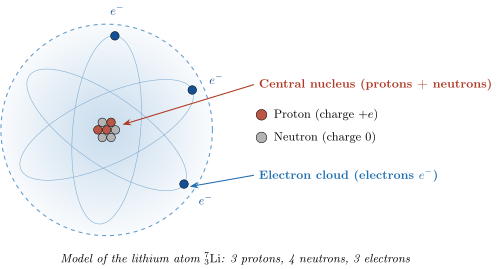
At the end of the 19th century and at the beginning of the 20th century, the work of J. J. Thomson (discovery of the electron in 1897), of Ernest Rutherford (discovery of the atomic nucleus in 1911) and of James Chadwick (discovery of the neutron in 1932) showed that the atom is not a solid, indivisible sphere, but a composite structure made of two distinct regions.
An atom is an electrically neutral chemical entity made of:
- a central nucleus, very dense and positively charged, which contains two types of particles called nucleons: the protons (carrying a positive charge) and the neutrons (electrically neutral);
- an electron cloud, a very extended region around the nucleus in which negatively charged particles move at very high speed: the electrons.
1.1.2 Mass and electric charge of subatomic particles
At the atomic scale, all electric charges are expressed as integer multiples of a fundamental quantity called the elementary charge, denoted :
where the coulomb () is the unit of electric charge in the International System (SI).
The three particles that make up the atom have the following characteristics in the International System:
{
| Particle | Location | Symbol | Electric charge | Mass |
|---|---|---|---|---|
| Proton | Nucleus | |||
| Neutron | Nucleus | |||
| Electron | Electron cloud |
- The proton and the neutron have extremely close masses; a common value called the mass of a nucleon is usually adopted:
- The ratio between the mass of a nucleon and that of an electron is:
An electron is therefore nearly two thousand times lighter than a proton or a neutron. Its mass is completely negligible compared with that of a nucleon.
Exercises of the chapter
- Subatomic identity card of common atoms solved
- Identifying a chemical element from its charge and its mass solved
- Lacunar structure and comparison of the masses in the carbon atom solved
- From the mass of an atom to the atomic molar mass solved
- Compared counting in three metal samples solved
- Density and number of atoms in a copper cylinder solved