Soaps, detergents and their impact on the environment
Course · Chemistry (Grade 11, Lebanon), chapter 9 · Lebanon, Grade 11 · the beginning of the chapter, the rest on Adloun
In the historic souks of Tripoli (in the famous Khan el-Saboun) and of Sidon, master soap makers have for centuries carried on the traditional making of soap from local olive oil, laurel berry oil and caustic soda. In the 20th century, the rise of petrochemistry and the spread of washing machines gave birth to synthetic detergents, able to wash effectively even in the hard water of mountain regions. However, the massive discharge of washing water into rivers and reservoirs — as in Lake Qaraoun in the Beqaa plain — has revealed serious ecological imbalances such as persistent foams and eutrophication.
This chapter first studies the preparation, the amphiphilic structure and the mechanism of the cleaning action of soaps, as well as their limits in hard or acidic water. It then presents the complete formulation of commercial synthetic detergents, before analyzing the environmental impact of surfactants and phosphates on aquatic ecosystems.
Curriculum: LB-1H
Required skills
- Name the raw materials used to make a soap and explain the principle of saponification and of salting out (using the word equation, without the expanded equation of the triglycerides).
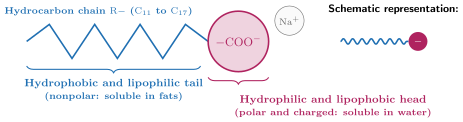
- Describe the amphiphilic structure of the carboxylate ion of a soap (polar hydrophilic head and long hydrophobic/lipophilic carbon chain ).
- Explain the four steps of the cleaning mechanism of a soap on a grease stain (wetting, attachment, emulsification into micelles, suspension) and draw a diagram of a micelle.
- Explain the loss of the foaming and cleaning power of soap in hard water (rich in and ions) and in acidic water.
- Identify the main constituents of a commercial detergent (synthetic surfactant, builders, bleaching agents, enzymes, fillers) and compare its properties with those of soap.
- Relate the structure of the carbon chain of a surfactant (linear or branched) to its biodegradability, and explain the mechanism of the eutrophication of water by phosphates.
9.1 Soaps: preparation, amphiphilic structure and mode of action
9.1.1 Raw materials and principle of soap making
A soap is obtained by a chemical reaction called saponification, carried out hot between two categories of raw materials:
- A fat (lipid) of plant origin (olive oil, laurel oil, palm oil, copra/coconut oil) or of animal origin (beef or mutton tallow). Chemically, fats consist mainly of triglycerides (triesters of glycerol and of fatty acids with a long carbon chain).
- A concentrated strong base: either an aqueous solution of sodium hydroxide (commonly called caustic soda), which leads to a hard soap, or a solution of potassium hydroxide (caustic potash), which leads to a soft soap (or black soap).
- Saponification is the complete and slow chemical reaction, carried out at boiling (), between a fat and a strong base ( or ). Its word equation is:
- Salting out is the physical operation that consists of adding the hot reaction mixture to a saturated aqueous solution of sodium chloride (salt water): since soap is only very slightly soluble in salt water, it precipitates as a solid and floats on the surface (its density being lower than that of the brine), while the glycerol and the excess sodium hydroxide remain dissolved in the lower aqueous phase. It then only remains to filter, wash, dry and mold the soap.
9.1.2 Chemical composition and amphiphilic structure of soap
A hard soap is a sodium carboxylate with the ionic formula and the molecular formula , where the group represents a long saturated or unsaturated carbon chain generally containing between and carbon atoms (for example in sodium stearate or in sodium oleate obtained from olive oil).
In aqueous solution, soap dissociates into sodium ions (inactive spectator ions) and carboxylate ions , which are the active chemical species of the soap.
The carboxylate ion has two parts with opposite affinities: it is said to be an amphiphilic species (and a surfactant):
- A hydrophilic (“water-loving”) and lipophobic (“fat-fearing”) head: this is the carboxylate group , polar and carrying a negative electric charge. It forms electrostatic attractions and hydrogen bonds with the polar water molecules.
- A hydrophobic (“water-fearing”) and lipophilic (“fat-loving”) tail: this is the long nonpolar hydrocarbon chain (). Repelled by water, it has on the other hand a strong affinity for fats, oils and nonpolar hydrocarbons.
Exercises of the chapter
- Making a traditional olive oil soap: saponification and salting out solved
- Amphiphilic structure of the carboxylate ion and mechanism of washing an oil stain solved
- Drawbacks of soap in hard, acidic or salt water: a quantitative study solved
- Decoding the formulation of a synthetic detergent and the structure of its surfactants solved
- Eutrophication of a lake by phosphates: ecological mechanism and oxygen curve solved
- Quantitative comparison of two laundry detergent formulations and phosphate removal solved