Kinetic factors, half-reaction time and catalysis
Course · Chemistry (Grade 12 General Sciences, Lebanon), chapter 2 · Lebanon, Grade 12 General Sciences · the beginning of the chapter, the rest on Adloun
Why are perishable foods kept in the refrigerator at or in the freezer at , whereas they are cooked quickly under pressure at about in a pressure cooker? Why does the catalytic converter of a car use a thin layer of platinum and rhodium deposited on a ceramic honeycomb support to transform, in a few milliseconds, toxic carbon monoxide and nitrogen oxides into harmless gases ( and )? In the chemical industry as in the living world, mastering how a chemical transformation proceeds requires knowing how to control its rate: speeding it up when the aim is to synthesize a drug or a polymer in an economically viable time, or on the contrary slowing it down and stopping it to preserve a product or to freeze a sample before analysis. This chapter first introduces the fundamental time indicator that is the half-reaction time , then systematically studies the action of the kinetic factors (temperature, initial concentration of the reactants) and the decisive role of catalysts — homogeneous, heterogeneous, enzymatic or autocatalytic.
Curriculum: LB-SG
Required skills
- Define and determine graphically the half-reaction time from the kinetic curve of a product, of the limiting reactant or of a reactant in excess.
- State and interpret at the microscopic scale the influence of temperature and of the initial concentration of the reactants on the reaction rate and on the half-reaction time .
- Plot and compare the shapes of the kinetic curves obtained by varying the temperature or the initial concentrations of the reactants.
- Explain the applications of kinetic factors in the laboratory (heating under reflux, thermal quenching and dilution) and in everyday life (preservation by cold, cooking in a pressure cooker).
- Define a catalyst and distinguish homogeneous catalysis, heterogeneous catalysis, enzymatic catalysis and autocatalysis; interpret the S-shaped kinetic curve of an autocatalyzed reaction.
- Illustrate the selectivity of a catalyst and justify that a catalyst speeds up the reaching of the final state without changing the equilibrium composition.
2.1 Half-reaction time
Since the kinetic curve of a slow reaction approaches its horizontal plateau asymptotically as , the exact instant at which the reaction is “completely finished” is poorly defined graphically. To characterize the time scale of a transformation by a precise and easily measurable duration, the half-reaction time is introduced.
2.1.1 General definition and expressions according to the species monitored
The half-reaction time, denoted , is the time after which the extent of the reaction has reached half of its final value (equal to if the reaction is complete):
From this general definition follow immediately three practical relations, depending on whether the kinetic curve studied represents a product, the limiting reactant or a reactant in excess:
- From a product (absent at ): the half-reaction time is the time after which the concentration (or the amount of substance) of the product formed reaches half of its maximum final value at :
- From the limiting reactant (of a complete reaction, where ): the half-reaction time is the time after which half of the initial amount of the limiting reactant has disappeared, so that exactly half of it remains:
- From a reactant in excess (or a reactant of a limited reaction, where ): the total amount of this reactant that disappears between and is . At time , only half of this consumable amount has disappeared:
The ordinate at is therefore the arithmetic mean of the initial concentration and the final concentration on the asymptote .
When a reactant is in excess, its concentration at is never equal to ! Indeed, if (large excess), the concentration never even reaches the value during the whole reaction. The half-sum must always be calculated.
2.1.2 Graphical determination and practical interest of
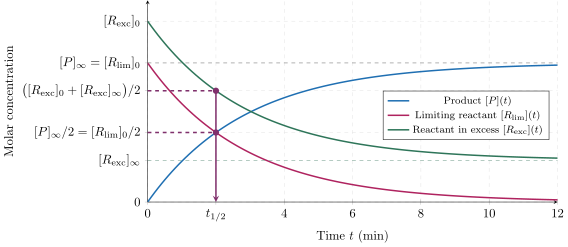
- Kinetic comparison criterion: the shorter the half-reaction time , the faster the reaction.
- Estimating the total duration of a reaction: since the reaction rate decreases over time, the second half of the reaction takes much longer than the first (). In experimental practice, a slow reaction is considered macroscopically finished (extent greater than of ) after a time of the order of:
Exercises of the chapter
- Half-reaction time on the curves of a product, of the limiting reactant and of a reactant in excess solved
- Crossing kinetic factors: temperature and initial concentrations solved
- Heating under reflux and food preservation: the two faces of temperature solved
- Comparative study of the catalyzed decomposition of hydrogen peroxide solved
- Heterogeneous catalysis, specific surface area and catalytic converter solved
- Autocatalysis and use of the inflection point of an S-shaped curve solved