Homogeneous chemical equilibrium and Le Chatelier's principle
Course · Chemistry (Grade 12 Life Sciences, Lebanon), chapter 3 · Lebanon, Grade 12 Life Sciences · the beginning of the chapter, the rest on Adloun
So far, we have mainly studied complete chemical transformations, which stop only when the limiting reactant is completely used up. Yet a large number of fundamental reactions of inorganic chemistry, organic chemistry and biochemistry are not complete: when one mole of ethanoic acid and one mole of ethanol are mixed, the evolution stops by itself while one third of a mole of each reactant remains, coexisting with two thirds of a mole of ester and water. Conversely, if one mole of ester and one mole of water are mixed, the system evolves in the opposite direction and stops exactly at this same final state! Such transformations are called limited (or reversible) and lead to a state of dynamic chemical equilibrium. This chapter establishes the quantitative laws that govern homogeneous chemical equilibrium in the liquid phase — conversion rate, Guldberg and Waage's law of mass action, equilibrium constant and reaction quotient — then shows how Le Chatelier's principle makes it possible to shift an equilibrium deliberately in order to improve the yield of a synthesis.
Curriculum: LB-SV
Required skills
- Distinguish a complete reaction from a limited (reversible) reaction and interpret at the microscopic scale the dynamic character of the state of chemical equilibrium ().
- Draw up the reaction table of a limited reaction and calculate the extent at equilibrium , the conversion rate (or final extent ratio) and the degree of dissociation of a reactant.
- Write the expression of the equilibrium constant (law of mass action) of a homogeneous equilibrium in the liquid phase, know its properties (it depends only on temperature) and calculate its value from the composition at equilibrium.
- Use the reaction quotient to predict the direction of spontaneous evolution of a chemical system out of equilibrium, and determine the final composition of a system from and its initial state.
- State and apply Le Chatelier's principle to predict the direction in which a chemical equilibrium shifts when a concentration is changed (addition or removal of a constituent) or the temperature varies, and justify why a catalyst has no effect on the position of equilibrium.
3.1 Limited reactions and the state of dynamic chemical equilibrium
3.1.1 Experimental evidence of reversibility
- A chemical reaction is said to be complete if, in the final state, at least one of the reactants (the limiting reactant) has entirely disappeared. Its final extent is equal to the theoretical maximum extent (), and its balanced equation is written with a single arrow .
- A chemical reaction is said to be limited (or incomplete, or reversible) if its evolution stops while all the reactants and all the products coexist in constant, non-zero amounts in the final state. Its final extent at equilibrium is strictly less than the maximum extent:
The final state of a limited reaction results from the simultaneous existence of two opposite reactions taking place in the same medium:
- the reaction in the forward direction (direction , from left to right): , with rate ;
- the reaction in the reverse direction (direction , from right to left): , with rate .
This reversibility is symbolized by a double arrow in the balanced equation:
3.1.2 Dynamic character of chemical equilibrium
When the state of equilibrium is reached, the concentrations no longer vary over time. At the macroscopic scale, nothing seems to happen any more; but at the microscopic scale, effective collisions continue in both directions!
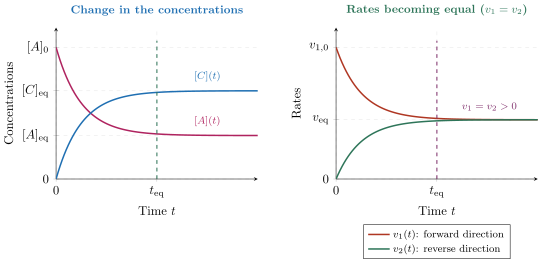
Suppose that at only the reactants and are mixed ():
- At the initial instant , the forward rate is maximum, while the reverse rate is zero () for lack of products.
- Over time, as and are consumed and and appear, the forward rate decreases while the reverse rate increases.
- The system reaches the state of chemical equilibrium from the instant at which the two opposite rates become equal and non-zero:
Per unit of time, exactly as much of each species is formed by one of the reactions as disappears by the opposite reaction: chemical equilibrium is a dynamic equilibrium (and not a static one).
3.2 Conversion rate and degree of dissociation
To characterize quantitatively how far a limited reaction has proceeded at equilibrium, the reaction table and the conversion rate (or final extent ratio) are used.
Method : Reaction table of a limited reaction
Consider the reaction starting from the initial amounts :
| State of the system | ||||
|---|---|---|---|---|
| Initial () | ||||
| In progress () | ||||
| Equilibrium () | ||||
| If complete () |
If the volume of the liquid phase is constant, exactly the same table can be drawn up directly in molar concentrations by replacing by and by the volumetric extent at equilibrium .
Exercises of the chapter
- Limited reaction, dynamic equilibrium and determination of solved
- Reaction quotient and evolution of an arbitrary mixture toward equilibrium solved
- Complexation equilibrium in aqueous solution () solved
- Successive disturbances of a homogeneous equilibrium (Le Chatelier) solved
- Controlling an equilibrium by continuous removal of a product solved
- Comparing curves approaching equilibrium (temperature and catalyst) solved