Space and the Universe: Hypotheses, Evidence and Research
Course · English for Science (Grade 11, Lebanon), chapter 5 · Lebanon, Grade 11 · the beginning of the chapter, the rest on Adloun
Nobody has ever touched a star. Almost everything we know about the universe has been reached by reasoning: an observation raises a question, a hypothesis answers it, a prediction puts the hypothesis at risk, and new evidence decides. Astronomy is therefore the best school for the skills of this chapter: formulating hypotheses aloud and in writing, criticizing evidence and the conclusions drawn from it, building the complex sentences that scientific reasoning needs, and conducting research in textbooks and other sources.
Curriculum: LB-1S
Learning objectives
- Formulate scientific hypotheses that can be tested, with the language of supposition and of degrees of certainty.
- Criticize evidence: ask where it comes from, what it really shows and whether the conclusion follows.
- Write complex sentences with relative, noun and adverbial clauses.
- Conduct research: ask a research question, derive pertinent information from a textbook and from other sources, evaluate the sources and synthesize them.
5.1 Formulating hypotheses
5.1.1 What a scientific hypothesis is
- A hypothesis is a proposed explanation of an observation, stated so that it can be tested. Plural: hypotheses.
- A prediction is what should be observed if the hypothesis is true. It is the prediction, not the hypothesis itself, that is compared with the facts.
- A theory is a broad explanation that has been tested many times and accounts for a large body of facts (the theory of gravitation). In science the word does not mean “a mere guess”.
- A law is a general statement, often mathematical, of what always happens in given conditions (Kepler's laws of planetary motion). A law describes; a theory explains.
Method : — Three qualities of a good hypothesis
- It explains the observation that raised the question.
- It is testable: one can say what observation would show it to be false. “The planets move as they do because it is their nature” cannot be tested; “the planets are held in their orbits by the attraction of the Sun, which decreases with distance” can.
- It is precise and simple: it states which quantity depends on which, and assumes no more than is needed.
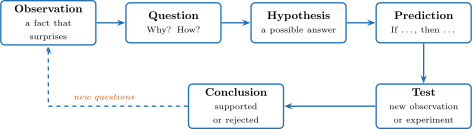
A convenient pattern: If [hypothesis] is true, then [prediction] should be observed, because [reason].
Observation: Venus is nearly twice as far from the Sun as Mercury, yet its mean temperature (464 °{}C) is far higher than that of Mercury (167 °{}C).
Question: Why is a planet that receives less sunlight hotter?
Hypothesis: The dense atmosphere of Venus, which consists mainly of carbon dioxide, traps the heat radiated by the surface.
Prediction: If this is true, then the night side of Venus should be almost as hot as the day side, because the atmosphere prevents the heat from escaping; on Mercury, which has almost no atmosphere, the night side should be extremely cold.
Test: measurements by space probes confirm both parts of the prediction. The hypothesis is supported.
5.1.2 The language of hypothesis
Property : — Saying that something is supposed, not known
| Introducing a hypothesis | One possible explanation is that…; It may be that…; We suggest / propose that…; It is thought that…; Suppose that…; Let us assume that… |
| Modal verbs | The lines may / might / could be an illusion (possibility); they must be very long (logical necessity); they cannot be rivers (logical impossibility) |
| About the past | Water may have flowed on Mars; the crater must have been formed by an impact; it cannot have been a volcano. |
| Verbs and adverbs | seem, appear, suggest, indicate; probably, possibly, presumably, apparently |
| Stating the prediction | If this is correct, we should find…; This would imply that…; We would expect… |
| After the test | The hypothesis is supported by / consistent with…; is contradicted by…; must be rejected / revised. |
A successful test supports a hypothesis; it does not prove it once and for all, because a later observation may still contradict it. A single well-established contrary fact, on the other hand, is enough to refute it. Write The results support the hypothesis, not “The results prove the hypothesis.” Note also the spelling and pronunciation: one hypothesis, two hypotheses; the verb is hypothesize; the adjective hypothetical.
- Induction goes from particular cases to a general rule: Every planet observed so far moves in an ellipse; therefore all planets move in ellipses. Its conclusion is probable, never certain.
- Deduction goes from a general rule to a particular case: All planets move in ellipses; Mars is a planet; therefore Mars moves in an ellipse. Its conclusion is certain if the rule is true.
Science uses both in turn: induction to form hypotheses and laws, deduction to draw from them the predictions that will be tested.
5.2 Criticizing evidence and drawing conclusions
5.2.1 Weighing evidence
Evidence is the body of facts offered in support of a claim. The word is uncountable: a piece of evidence, much evidence, the evidence shows (never “evidences”). A claim is a statement presented as true; an argument is a claim together with the evidence and reasoning that support it.
Method : — Six questions to put to any piece of evidence
- Source: who observed or measured this? With what instrument? Was the observer competent, and had he or she an interest in the result?
- Kind: is it a measurement, an experiment, a single observation, a testimony, an opinion?
- Quantity: how many cases? One night or a hundred? One patient or a thousand?
- Repeatability: have independent observers found the same thing?
- Alternative explanations: could something else produce the same facts (chance, an illusion, a defect of the instrument, a third factor)?
- Inference: does the conclusion really follow from the evidence, or does it say more than the facts allow?
Exercises of the chapter
- Watching a hypothesis change: Galileo and the “little stars” (1610) solved
- What a hypothesis is worth: T. H. Huxley's lecture to working men (1863) solved
- Evidence and inference: Percival Lowell on the “canals” of Mars (1895) solved
- A critique by a scientist: Alfred Russel Wallace answers Lowell (1907) solved
- Complex sentences: writing a paragraph about the solar system solved
- Testing a hypothesis with data: distance and length of the year solved