Neurotransmitters and medical applications
Course · Life Sciences (Grade 12 Life Sciences, Lebanon), chapter 11 · Lebanon, Grade 12 Life Sciences · the beginning of the chapter, the rest on Adloun
A South American hunter coats his arrow with a plant extract, and the animal he hits collapses, its muscles limp. A surgeon relieves a patient with a substance drawn from the poppy. A person with Parkinson's disease recovers smooth movements for a few hours after swallowing a tablet. In all three cases, a molecule foreign to the body acts on one precise step of the functioning of a synapse. Because the synapse works through chemical messengers and receptors, it is the place where medicines, poisons and drugs act on the nervous system. How do neurotransmitters act on their receptors, how is pain modulated, and how can a molecule imitate, strengthen or block a neurotransmitter?
Curriculum: LB-SV
Required skills
- Explain the functioning of a receptor-channel and relate the ion that crosses it to the excitatory or inhibitory effect of the neurotransmitter.
- Describe the pathway of pain and explain its modulation by enkephalins.
- Explain the analgesic action of morphine from its structural analogy with enkephalins.
- Relate a disease of the nervous system (Parkinson's disease, Alzheimer's disease) to a deficit in a neurotransmitter and justify a treatment.
- Identify, from experimental results, the site of action of a substance on a synapse (agonist, antagonist, effect on release, breakdown or reuptake).
- Explain the notions of tolerance and dependence.
11.1 Neurotransmitters and receptor-channels
Problem. A neurotransmitter does not enter the postsynaptic cell. How can the mere binding of a molecule to the membrane produce an electrical signal, and why is this signal sometimes excitatory and sometimes inhibitory?
At a chemical synapse, the arrival of an action potential triggers the exocytosis of a neurotransmitter, which diffuses in the cleft and binds to receptors of the postsynaptic membrane. The postsynaptic response is an EPSP (depolarization) or an IPSP (hyperpolarization).
11.1.1 A receptor that is also a channel
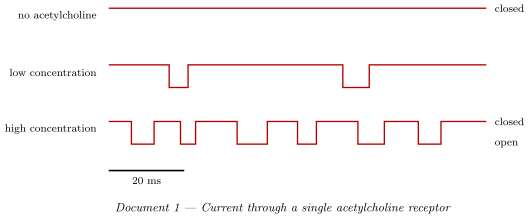
A technique makes it possible to isolate, at the tip of a micropipette, a tiny patch of postsynaptic membrane that contains a single receptor, and to record the electric current that crosses it. The recordings below were obtained on a patch of muscle membrane, with increasing concentrations of acetylcholine in the pipette (shape of the recordings after the classic experiments; each downward step is an entry of positive charges).
Proof (Analysis)
- Without acetylcholine, no current crosses the patch: the receptor lets nothing through.
- With acetylcholine, the current appears in brief rectangular steps, all of the same amplitude: the receptor switches abruptly between two states, closed and open. It is a channel, which opens when acetylcholine binds to it and closes when acetylcholine leaves it.
- At a higher concentration, the steps keep the same amplitude but are more frequent: 2 openings in the recording at low concentration, 7 at high concentration. The concentration of the neurotransmitter does not change the current through one channel; it changes the probability that a channel is open.
A receptor-channel is a protein of the postsynaptic membrane that has both a binding site specific to a neurotransmitter and a channel for ions. The binding of the neurotransmitter opens the channel; its departure closes it. A receptor-channel is opened by a chemical messenger, whereas a voltage-gated channel is opened by a depolarization.
The amplitude of a postsynaptic potential depends on the number of receptor-channels open at the same time, hence on the quantity of neurotransmitter released: the chemical message is coded in concentration.
11.1.2 The ion decides the effect
{
| Neurotransmitter | Receptor-channel | Ion that crosses | Postsynaptic effect |
|---|---|---|---|
| acetylcholine | nicotinic receptor (neuromuscular junction) | enters (cations) | depolarization: EPSP |
| glutamate | glutamate receptors (brain, spinal cord) | enters (cations) | depolarization: EPSP |
| GABA | GABA receptor (brain) | enters | hyperpolarization: IPSP |
Document 2 — Three neurotransmitters and their receptor-channels}
Proof (Analysis)
A neurotransmitter is neither excitatory nor inhibitory in itself: the effect depends on the receptor-channel to which it binds. A channel for cations lets enter, which brings positive charges inside: the membrane depolarizes and moves closer to the threshold. A channel for brings negative charges inside: the membrane hyperpolarizes and moves away from the threshold.
- Acetylcholine: neuromuscular junction (excitatory); also present in the brain, where it takes part in memory.
- Glutamate: the main excitatory neurotransmitter of the central nervous system.
- GABA: the main inhibitory neurotransmitter of the brain.
- Dopamine, norepinephrine, serotonin: neurotransmitters of circuits of the brain involved in movement, alertness, mood and the feeling of reward.
- Substance P and enkephalins: small peptides involved in the transmission and in the control of pain. Enkephalins belong to the family of the endorphins, the morphine-like substances made by the body itself.
Each neurotransmitter is synthesized by the presynaptic neuron, stored in vesicles, released by exocytosis, recognized by specific receptors, then removed from the cleft by an enzyme or by reuptake. Each of these steps is a possible target for a foreign molecule.