Deficiencies and malfunctioning of the immune system
Course · Life Sciences (Grade 12 Life Sciences, Lebanon), chapter 7 · Lebanon, Grade 12 Life Sciences · the beginning of the chapter, the rest on Adloun
A fungus that lives harmlessly in the lungs of most people can kill a patient whose T4 lymphocytes have collapsed. In another patient, lymphocytes that work perfectly well destroy, cell after cell, the only cells of the body able to make insulin. In the first case the immune system does too little; in the second it attacks what it should protect. These two failures, immunodeficiency and autoimmunity, show by contrast what a healthy immune system achieves every day: defending the body without attacking it.
Curriculum: LB-SV
Required skills
- Distinguish a congenital immunodeficiency from an acquired one.
- Describe how HIV infects T4 lymphocytes and explain why their loss disarms both specific responses.
- Interpret the curves of an HIV infection: T4 lymphocytes, viral load, antibodies; identify its three phases.
- Explain the principle of screening and the modes of transmission and prevention of HIV.
- Define an autoimmune disease as a breakdown of self-tolerance, and explain three examples: type 1 diabetes, multiple sclerosis, myasthenia gravis.
- Interpret experimental results on an animal model of an autoimmune disease.
7.1 Immunodeficiencies
Problem. What happens to the body when a population of immune cells is missing, from birth or after an infection?
7.1.1 Congenital immunodeficiencies
Some children are born with an immune system that lacks one of its components, because of a genetic anomaly or of an abnormal development of an organ. The table gives two examples.
{
| Child born without a thymus | Severe combined immunodeficiency | |
|---|---|---|
| Origin | the thymus did not form during embryonic development | a mutated gene prevents the lymphocytes from developing |
| T lymphocytes in the blood | absent or very rare | absent or very rare |
| B lymphocytes in the blood | present | absent or unable to function |
| Antibodies after vaccination | very few | none |
| Consequences | repeated, severe infections, especially by viruses and fungi | severe infections from the first months of life; fatal without treatment |
| Possible treatment | graft of thymus tissue | life in a sterile environment, then graft of compatible bone marrow |
Document 1 — Two congenital immunodeficiencies}
Proof (Analysis)
- Without a thymus, T lymphocytes cannot mature: the cell-mediated response is absent. Although B lymphocytes are present, the child makes very few antibodies: without T helper lymphocytes, the selected B lymphocytes are not stimulated. The absence of one population thus weakens both specific responses.
- In severe combined immunodeficiency, both T and B lymphocytes are missing or inactive: no specific response is possible. Only the non-specific response remains, and it is not enough.
- The treatments supply what is missing: thymus tissue in the first case, the stem cells of the bone marrow, from which all lymphocytes derive, in the second. The bone marrow must come from a donor whose HLA molecules are compatible.
An immunodeficiency (immune deficiency) is a state in which the immune system, partly or wholly failing, no longer protects the body against infections. It is congenital when it is present from birth, and acquired when it appears during life, as a result of an infection, of a treatment or of severe malnutrition.
7.1.2 An acquired immunodeficiency: AIDS
AIDS (acquired immunodeficiency syndrome) is caused by the human immunodeficiency virus (HIV), identified in 1983 at the Institut Pasteur in Paris. According to UNAIDS, about 41 million people were living with HIV in 2025.
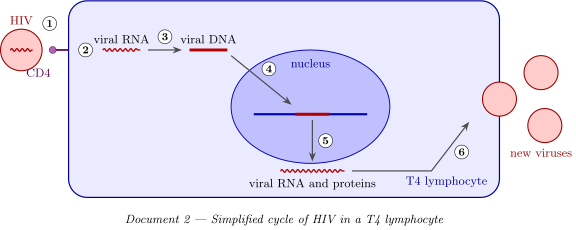
The virus and its target. HIV is a retrovirus: its genetic material is RNA, and the viral particle carries an enzyme, reverse transcriptase, which copies this RNA into DNA. Its envelope bears a protein, gp120, which binds specifically to the CD4 molecule. HIV therefore infects the cells that carry CD4: above all the T4 lymphocytes, and also macrophages.
Proof (Analysis)
- Binding: the protein gp120 of the virus binds to the CD4 molecule of the T4 lymphocyte.
- Entry: the envelope of the virus fuses with the cell membrane; the viral RNA and the reverse transcriptase enter the cytoplasm.
- Reverse transcription: the reverse transcriptase copies the viral RNA into viral DNA.
- Integration: the viral DNA enters the nucleus and is inserted into the DNA of the cell. It can remain silent there for years.
- Expression: the cell transcribes the viral DNA; viral RNA and viral proteins are produced.
- Budding: new viral particles are assembled, leave the cell and infect other cells. The infected lymphocyte finally dies.