Controlling reproduction
Course · Life Sciences (Grade 12 Life Sciences, Lebanon), chapter 9 · Lebanon, Grade 12 Life Sciences · the beginning of the chapter, the rest on Adloun
For most of human history, having a child or not was left to chance. Once the hormonal dialogue between the brain, the pituitary gland and the ovaries had been understood, it became possible to act on it: to prevent a pregnancy with molecules that imitate the natural hormones, or, on the contrary, to help a couple who cannot conceive. Each of these techniques acts at a precise point of the chain that leads from the gametes to the implanted embryo. Where does each method act, and why does it work?
Curriculum: LB-SV
Required skills
- Classify the contraceptive methods according to their level of action: preventing the meeting of the gametes, preventing ovulation, preventing implantation.
- Explain, from hormone curves, how the combined pill prevents ovulation through the negative feedback.
- Explain the mode of action of a contragestive molecule, RU 486, from its affinity for the progesterone receptors.
- Relate a cause of infertility to a technique of medically assisted procreation.
- Describe the steps of in vitro fertilization and embryo transfer (IVF-ET) and of ICSI.
- Interpret assays, experiments and semen analyses related to the control of reproduction.
9.1 Contraceptive methods
Problem. A pregnancy begins only if a series of events follow one another without interruption. Which of these events can be prevented, and how?
For a pregnancy to begin, an oocyte must be released by an ovary (ovulation), sperm cells must cross the cervix and meet the oocyte in the oviduct (fertilization), and the embryo, about a week after fertilization, must implant in a receptive endometrium (implantation). Sperm cells survive three to five days in the female reproductive tract; the oocyte can be fertilized for 12 to 24 hours after ovulation.
9.1.1 Three levels of action
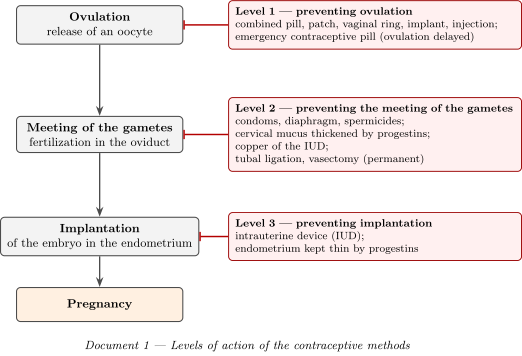
Contraception is the set of reversible methods that prevent a pregnancy from starting. Document 1 places the main methods on the path that leads to a pregnancy.
Proof (Analysis)
Each method interrupts the chain at one or several points. Barrier methods (condoms, diaphragm) physically separate the gametes; the condom is, in addition, the only method that protects against sexually transmitted infections, including HIV. Hormonal methods act mainly on ovulation, but also on the cervical mucus and on the endometrium. The intrauterine device acts inside the uterus.
9.1.2 The combined pill: preventing ovulation
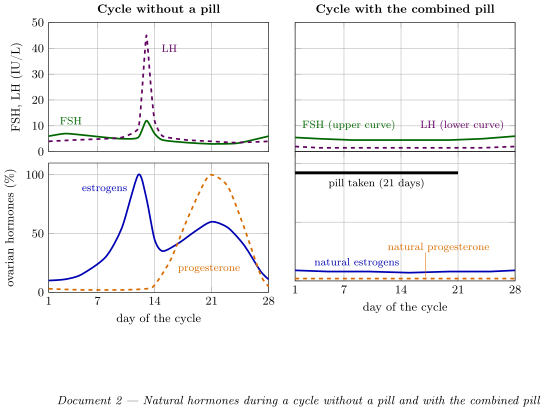
The combined pill contains two synthetic hormones: an estrogen and a progestin, a molecule that has the effects of progesterone. In its classic form, it is taken every day for 21 days, followed by a pause of 7 days. Document 2 compares the hormones measured in the blood of a woman during a cycle without a pill, then during a cycle with the pill (typical values for FSH and LH; ovarian hormones in percent of their maximum in the natural cycle; the synthetic hormones of the pill are not shown).
Proof (Analysis)
- Without a pill, the curves are those of a normal cycle: peak of estrogens, LH surge on D13, ovulation, then progesterone secreted by the corpus luteum.
- With the pill, FSH and LH remain low and flat (about 5 and 2 IU/L): there is no LH surge. The natural estrogens stay at their lowest level (no dominant follicle) and progesterone remains almost zero (no corpus luteum).
- Interpretation. The synthetic estrogen and progestin of the pill, present every day at a moderate, constant concentration, exert a permanent negative feedback on the hypothalamo-pituitary axis. FSH is too low for a follicle to mature; the natural estrogens never reach the level that would trigger the positive feedback; there is no LH surge, hence no ovulation.
The combined pill acts at three levels, the first being the main one:
- on the hypothalamo-pituitary axis: negative feedback, FSH and LH low, no LH surge, no ovulation; the ovaries are at rest;
- on the cervical mucus: the progestin keeps it thick, with a dense mesh that sperm cells cannot cross;
- on the endometrium: it remains thin and is not receptive to implantation.
During the 7-day pause, the synthetic hormones fall: the endometrium breaks down and bleeding occurs, as at the end of a natural cycle. The effect of the pill is reversible: cycles resume when it is stopped.
The progestin-only pill (mini-pill), the implant placed under the skin of the arm, the injection, the patch and the vaginal ring are based on the same hormones. Progestins alone act above all on the cervical mucus and on the endometrium; depending on the dose, they also block ovulation. The choice of a method and its prescription are a matter for a health professional.
9.1.3 The intrauterine device and emergency contraception
The intrauterine device (IUD) is a small device placed in the uterus by a health professional, for several years.
- The copper IUD releases copper ions, which are toxic to sperm cells: it acts first by preventing fertilization. It also causes a local reaction of the endometrium that makes implantation unlikely.
- The hormonal IUD releases a progestin: the cervical mucus is thick and the endometrium remains thin.
The emergency contraceptive pill (morning-after pill) is taken as soon as possible after unprotected intercourse, within 72 hours for the most common one, which contains a large dose of a progestin. It has long been presented as a method that prevents implantation. The studies available today show that it acts mainly by blocking or delaying ovulation: it is effective only if ovulation has not yet taken place, and it does not interrupt an implanted pregnancy. Many textbooks and exam documents still classify it among the methods that prevent implantation: in an exam, reason from the documents provided. It is an emergency method, less effective than a regular method.