The basic principles of a balanced diet
Course · Life Sciences (Grade 12 Sociology and Economics, Literature and Humanities, Lebanon), chapter 1 · Lebanon, Grade 12 Sociology and Economics, Literature and Humanities · the beginning of the chapter, the rest on Adloun
Every day we choose what to eat: a man'oushe (a Lebanese flatbread) at breakfast, a plate of mujaddara at lunch, fruit in the afternoon. These choices are not neutral. The body spends energy all the time, even during sleep, and it is food that supplies this energy; the body also renews its cells, and food supplies the matter for them. How much must we eat? Are all foods equivalent, provided we eat enough of them? And how can the meals of a day be put together so that they cover all the needs of the body?
Curriculum: LB-SE LB-LH
Required skills
- Explain that the energy needs of a person depend on basal metabolism and activity, and vary with age, sex, activity and physiological state.
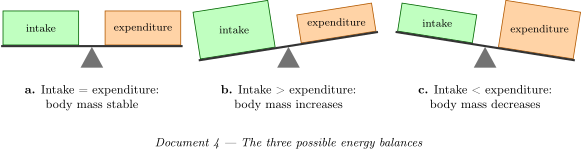
- Draw up an energy balance (intake and expenditure) and predict its effect on body mass.
- Calculate the energy supplied by a food or a meal from its content in carbohydrates, lipids and proteins.
- Distinguish energy foods from building foods.
- Define an essential amino acid and an essential fatty acid; explain the complementarity of cereals and legumes.
- State that vitamins and minerals are needed in very small quantities and that their lack causes disorders (from documents).
- State the rules of a balanced food ration, then calculate and criticize a ration.
1.1 Quantitative needs: energy needs
Problem. The body spends energy at every moment. Where does this expenditure come from, and how much energy must food supply each day?
1.1.1 Energy expenditure
Even lying still, asleep, the body spends energy: the heart beats, the lungs ventilate, the brain works and the body temperature is kept at about . This minimum expenditure, measured at complete rest and fasting, is the basal metabolism. All the activities of the day are added to it: standing, walking, working, practicing a sport, and, in a young person, growing.
The energy expenditure of a person is the energy that the body uses in a day. It is the sum of the basal metabolism (the expenditure of the body at complete rest, needed to keep the vital functions going) and of the expenditure linked to activity. It is expressed in kilojoules (kJ) per day.
{
| Activity (for a 60 kg adolescent) | Duration | Energy spent (kJ) |
|---|---|---|
| Sleeping | 9 h | |
| Sitting in class, studying | 8 h | |
| Standing, light activities | 4 h | |
| Walking | 1 h | |
| Playing football | 1 h | |
| Other activities | 1 h | 700 |
| Total for the day | 24 h |
Document 1 — Energy spent during one day (illustrative data, orders of magnitude)
Proof (Analysis)
- Even during the 9 hours of sleep, the body spends kJ: this is close to the basal metabolism.
- One hour of football costs as much energy as four hours of standing activities: the more intense the activity, the higher the expenditure.
- Over the day, this adolescent spends about kJ. Food must supply the same quantity.
1.1.2 Needs that vary from one person to another
The energy need of a person is the quantity of energy that food must supply each day to cover the expenditure (and, in a young person, growth). It is not the same for everyone.
{
| Person (moderate physical activity) | Energy need (kJ per day) |
|---|---|
| Girl aged 15--16 | about |
| Boy aged 15--16 | about |
Document 2 — Energy needs of adolescents (after FAO/WHO/UNU, 2004, rounded)
Proof (Analysis)
At the same age and with the same activity, the need of a boy is higher than that of a girl, mainly because his body mass and his muscle mass are on average greater. The need also changes with:
- age: it rises during childhood, is very high in adolescence, when growth is fast, then falls in elderly people;
- physical activity: a builder or an athlete needs much more energy than a person who works sitting down;
- the physiological state: pregnancy and breastfeeding increase the need of a woman, since she builds the tissues of the fetus, then makes milk.
The energy need of a person depends on age, sex, physical activity and physiological state (growth, pregnancy, breastfeeding). There is therefore no quantity of food valid for everyone.
1.1.3 The energy supplied by food
The energy of food comes from three organic nutrients: carbohydrates, lipids and proteins. Water, minerals and vitamins supply no energy. The energy value of a nutrient is the energy released by one gram of it in the body.
{
| Nutrient | Energy value (kJ per gram) |
|---|---|
| Carbohydrates | 17 |
| Proteins | 17 |
| Lipids | 38 |
Document 3 — Energy value of the three energy-supplying nutrients
Method : : Calculating the energy supplied by a food
- Read in a composition table the mass of carbohydrates, lipids and proteins contained in the quantity of food eaten.
- Multiply each mass (in g) by its energy value: 17 kJ for carbohydrates and proteins, 38 kJ for lipids.
- Add the three results.
A labneh sandwich contains 45 g of carbohydrates, 10 g of lipids and 12 g of proteins. It supplies kJ, that is, about kJ.
Food labels often give the energy in kilocalories (kcal), also written “Calories.” One kilocalorie is about kJ.
1.1.4 The energy balance
The energy balance compares, over the same period, the energy intake (food) and the energy expenditure.
Exercises of the chapter
- A day in the life of a student solved
- Two brothers, two balances solved
- A protein that is not enough solved
- Brown rice, white rice solved
- Enough iron? solved
- Is this ration balanced? solved