Statistical vocabulary
Course · Mathematics (Grade 10, Lebanon), chapter 1 · Lebanon, Grade 10 · the beginning of the chapter, the rest on Adloun
Counting the inhabitants of a region, checking the diameter of the parts produced by a machine shop, analyzing the monthly rainfall in the Bekaa plain or surveying the means of transport used by the households of a city: in all these situations, a large number of raw observations are collected, which are impossible to interpret at a single glance. Descriptive statistics provides a precise and rigorous language for organizing, classifying and summarizing these data without distorting their meaning.
This first chapter lays the foundations of this language: it defines the set studied (population, individual, sample), distinguishes the nature of what is observed (qualitative or quantitative variable, discrete or continuous grouped into classes), then organizes the counting of the observations using frequencies and relative frequencies.
Curriculum: LB-2
Required skills
- Identify, in a statistical study, the population, the individual (or statistical unit), a sample and the size of the population.
- Distinguish a census from a survey.
- Recognize a statistical variable (or statistical characteristic) and specify its nature: qualitative (nominal or ordinal), discrete quantitative or continuous quantitative.
- Determine, for a continuous variable grouped into classes , the width and the midpoint of each class.
- Calculate the frequencies , the total frequency , the relative frequencies and the percentage frequencies , and draw up the associated statistical table.
1.1 Populations and individuals
1.1.1 Population, individual and size
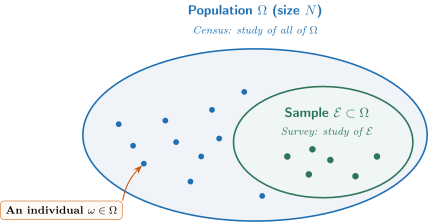
- The population (often denoted ) is the clearly delimited reference set covered by a statistical study.
- Each element of this population is called an individual or a statistical unit.
- The total number of individuals making up the population is called the size (or the total frequency) of the population; it is generally denoted ().
In everyday language, an individual means a person. In statistics, this term is purely set-theoretic: an individual can be a human being (a patient, an employee, a subscriber), but also an animal, a plant, a material object (a car, an electric light bulb, a machined part), an economic entity (a household, a company) or even a unit of time (a day of weather records).
Let us consider three distinct statistical surveys:
- Agricultural study: The annual yield of the olive groves of a rural cooperative is recorded.
- Population: the set of the olive groves of the cooperative.
- Individual: an olive grove of the cooperative.
- Size of the population: .
- Industrial inspection: A laboratory checks the mass of the tablets of a pharmaceutical batch.
- Population: the batch of tablets.
- Individual: a tablet of the batch.
- Size of the population: .
- Weather observation: The amount of rain that fell each day of the month of January at a coastal station is measured.
- Population: the set of the days of the month of January.
- Individual: a day of the month of January.
- Size of the population: .
1.1.2 Sample, census and survey
In many studies, observing each individual of the population one by one is impossible, too expensive, too long, or leads to the destruction of the observed individual (for example when measuring the lifetime of a lamp until it burns out, or the breaking load of a steel cable). We then restrict ourselves to a part of the population.
- A sample is a subset taken from the population (). The number of individuals making up the sample is called the size of the sample.
- When the observation covers all the individuals of the population without exception, the study is called a census (exhaustive study).
- When the observation covers only a sample in order to draw estimates about the whole population, the study is called a survey (or sample survey).
For a survey to give a faithful picture of the whole population, the sample taken must be representative, that is, chosen without bias (for example by random drawing) and of sufficient size. Questioning only the passers-by of a shopping district at noon does not provide a representative sample of all the inhabitants of a town.
1.2 Variables
1.2.1 Variable and values
On the same population, we may be interested in several different aspects: for a group of employees of a company, we may record their seniority, their monthly salary, their department or their means of transport. Each of these aspects constitutes a statistical variable.
- A statistical variable (or statistical characteristic) is any property or quantity observed on each of the individuals of the population.
- The different situations, categories or values that this variable can take are called the values (or modalities) of the variable. When there are of them, they are generally denoted .
If we study the blood group of donors:
- the population is the set of the donors (and not the blood groups);
- the variable is ``the blood group'';
- the values are the four possible categories: , , and (there are values, whereas there are individuals).
Exercises of the chapter
- Identifying the population, the individual, the sample and the type of survey solved
- Classifying statistical variables: qualitative or quantitative, discrete or continuous solved
- Bounds, widths and midpoints of the classes of a continuous variable solved
- Tallying raw data and building a table of frequencies and relative frequencies solved
- Completing an incomplete statistical table by proportionality solved
- Comparing two populations of different sizes using relative frequencies solved