Lines and planes – Relative positions
Course · Mathematics (Grade 10, Lebanon), chapter 22 · Lebanon, Grade 10 · the beginning of the chapter, the rest on Adloun
In the plane, two lines that do not meet are necessarily parallel. In space, this equivalence disappears: a road passing over a bridge and a railway track passing under this bridge never meet, but do not have the same direction — they are non-coplanar lines. Similarly, the interaction between lines and planes brings out configurations specific to dimension three, the most famous of which is the roof theorem: when the two sloping sides of a roof rest on two parallel side walls, the ridge where they join is necessarily parallel to these two walls.
This chapter methodically studies the relative positions of two planes, of two lines, then of a line and a plane in space. It establishes the fundamental theorems of parallelism — transitivity, section of two parallel planes by a third plane, criterion for the parallelism of a line and a plane, roof theorem — and shows how these theorems considerably simplify the determination of lines of intersection of planes and the construction of plane sections of common solids.
Curriculum: LB-2
Required skills
- Identify and justify the relative position of two planes (parallel or intersecting along a line), of two lines (coplanar — intersecting or parallel — or non-coplanar) and of a line and a plane (line contained in the plane, intersecting at a point or strictly parallel).
- Prove that two lines are parallel (in particular by transitivity or by the midpoint theorem) or that they are non-coplanar.
- Prove that a line is parallel to a plane by means of a line contained in this plane, and prove that two planes are parallel by means of two pairs of parallel intersecting lines.
- Know, prove and apply the property of intersection of a plane with two parallel planes as well as the roof theorem to determine the line of intersection of two planes.
- Construct the plane section of a common solid (cube, rectangular prism, prism, pyramid, tetrahedron) by using the properties of parallelism.
22.1 Relative position of two planes
22.1.1 Parallel planes and intersecting planes
Let and be two planes of space. By the axiom of intersection of two planes, if and are distinct and have at least one common point, they intersect along a whole line. There are therefore only three possible situations.
Two planes and of space are:
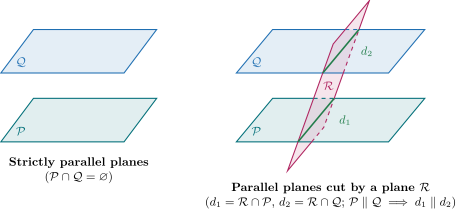
- either strictly parallel if they have no common point ();
- or coincident if they have the same points ();
- or intersecting if they are distinct and have at least one common point: their intersection is then a line ().
We say that two planes and are parallel, and we write , when they are strictly parallel or coincident:
In a rectangular prism , the planes of opposite faces are strictly parallel in pairs: , and . On the other hand, two faces with a common edge have planes that intersect along this edge: for example .
22.1.2 Properties of parallel planes
We accept Euclid's postulate for planes: through every point of space there passes a unique plane parallel to a given plane .
If two planes are parallel to the same third plane, then they are parallel to each other:
Proof
Suppose, for contradiction, that and are not parallel: they would then have at least one common point . Through this point there would pass two distinct planes and both parallel to the plane , which contradicts the uniqueness of the plane parallel to passing through . So .
If two planes and are parallel, then every plane that intersects one also intersects the other, and the two lines of intersection and are parallel:
Proof
If , then and the lines are coincident, hence parallel. Suppose and are strictly parallel (), and let be a plane intersecting along a line . The plane cannot be parallel to , otherwise by transitivity ( and ) we would have , which is excluded since intersects along . The plane therefore also intersects along a line . The two lines and are both contained in the same plane : they are coplanar. Moreover, since and with , the lines and can have no common point (). Two coplanar lines with no common point being strictly parallel, we conclude that .
If a plane contains two intersecting lines and respectively parallel to two intersecting lines and of a plane , then the planes and are parallel ().
The proof of this criterion rests on a theorem of the last section of the chapter: it is written out after this theorem.
Exercises of the chapter
- Relative positions of lines and planes in a right prism with a triangular base solved
- Parallel planes in a cube and section by a plane parallel to two lines solved
- The roof theorem in a tetrahedron: line of intersection and point of concurrence solved
- Varignon's theorem in space, bimedians of a tetrahedron and rhombus conditions solved
- Section of a regular pyramid by a plane parallel to two edges solved
- Section of a cube using the parallelism of opposite faces solved