Second-degree equations
Course · Mathematics (Grade 11 Humanities, Lebanon), chapter 1 · Lebanon, Grade 11 Humanities · the beginning of the chapter, the rest on Adloun
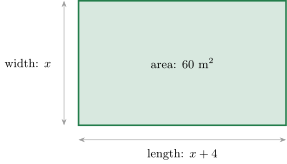
A rectangular garden has an area of and its length exceeds its width by : what are its dimensions? If we call the width, the length is and the area is ; so we must find such that . The unknown appears squared: this is a second-degree equation. Such equations come up as soon as we deal with an area, a revenue (a price multiplied by a quantity that depends on this price) or a sharing problem.
This chapter teaches how to recognize a second-degree equation, how to solve directly those in which a term is missing, and then how to solve all the others using a single number, the discriminant . It then shows what the sum and the product of the two solutions are equal to, and how to find two numbers whose sum and product are known.
Curriculum: LB-1H
Required skills
- Recognize a second-degree equation (), read its coefficients , and , check that a number is a solution of it.
- Solve an incomplete equation of the type or .
- Calculate the discriminant , deduce the number of solutions of the equation, then calculate them.
- Know the sum and the product of the roots, and use them to check a result or to find a root when the other one is known.
- Find two real numbers whose sum and product are known.
1.1 Studying the second-degree equation
1.1.1 Recognizing a second-degree equation
A second-degree equation in the unknown is any equation that can be written in the form
where , and are three given real numbers, with .
- The numbers , and are the coefficients of the equation: is the coefficient of , that of , and is the constant term.
- A real number is a solution (we also say a root) of the equation if the equality is true when is replaced by this number.
- To solve the equation is to find all its solutions. Their set is denoted .
| Equation | |||
|---|---|---|---|
The sign is part of the coefficient: in , we have and not . When a term is missing, its coefficient is .
If , the term disappears: what remains is , which is a first-degree equation. So it is the presence of the term that makes the equation second-degree.
1.1.2 Writing the equation in the form
A second-degree equation is not always given in standard order. Before reading the coefficients, we bring all the terms to the left-hand side, expand and combine like terms.
- The garden equation, , is written : we subtracted from both sides. Here , and .
- The equation expands to , and is then written . Here , and .
- The equation is written , that is . Here , and .
1.1.3 Checking that a number is a solution
To find out whether a number is a solution, we put it in place of and calculate: we must get .
Let us go back to .
- For : . The number is a solution.
- For : . The number is not a solution.
- For : . The number is also a solution.
So the equation has two solutions, and . For the garden, a width is positive: we keep . The garden measures by , and we check that .
Testing numbers at random is not a method: we may search for a long time, and we never know whether we have found all the solutions. The following sections give reliable methods.
1.2 Solving incomplete second-degree equations
A second-degree equation is said to be incomplete when or . It can then be solved directly, without a formula.
1.2.1 Equation (the term is missing)
We isolate : the equation becomes , with . Everything then depends on the sign of , because a square is never negative.
- If , the equation has two opposite solutions: and .
- If , the equation has only one solution: .
- If , the equation has no real solution.
- is written . Since , there are two solutions: and . So .
- is written , then . There are two solutions: and . So , that is about and .
- is written . A square cannot be negative: there is no solution. So .
The equation has two solutions, because as well. Writing only is the most common mistake. On the other hand, in a concrete problem, we then discard the solution that makes no sense (a negative length, for example).
1.2.2 Equation (the constant term is missing)
Both terms contain : we factor out , then use the zero-product rule: a product is zero if, and only if, one of its factors is zero.
The equation () has the solutions and . The number is always a solution.
- is written . So or , that is or . Thus .
- is written . So or . Thus .
In , it is tempting to write and then to “cancel ” to get , that is . We then lose the solution : we are not allowed to divide by a number that may be zero. We factor, we do not divide.
Exercises of the chapter
- Incomplete equations solved
- Three equations, three cases solved
- Putting in order before solving solved
- Sum, product and the other root solved
- Two numbers to find solved
- A rectangle made of string solved