Antiderivatives
Course · Mathematics (Grade 11 Humanities, Lebanon), chapter 15 · Lebanon, Grade 11 Humanities · the beginning of the chapter, the rest on Adloun
A bus's speedometer shows its speed at every moment. Can we, from these speeds, find the distance it has traveled? A workshop knows what each additional object it makes costs it. Can it deduce its total cost?
In both cases, we know the derivative of a function (speed is the derivative of distance, the cost of one additional object is the derivative of the total cost) and we are looking for the function itself. Differentiating means going from a function to its derivative . This chapter takes the reverse path: a function whose derivative is is called an antiderivative of .
Curriculum: LB-1H
Required skills
- Check, by differentiating, that a function is an antiderivative of a function .
- Know that two antiderivatives of the same function on an interval differ by a constant.
- Know the antiderivatives of the usual functions: constants, , , .
- Calculate the antiderivatives of a polynomial and of a sum of usual functions.
- Determine the antiderivative that satisfies a given condition.
15.1 Definition of an antiderivative
15.1.1 Going back from a derivative to the function
We know that the derivative of is . Let us ask the question the other way round: which function has derivative ? The function works. We say that is an antiderivative of .
Let be a function defined on an interval . An antiderivative of on is a function , differentiable on , whose derivative is :
An antiderivative is often denoted by the corresponding capital letter: for an antiderivative of , for an antiderivative of .
- is an antiderivative of on , because .
- is an antiderivative of on , because .
- is an antiderivative of for , because .
Method : Checking that a function is an antiderivative of
Differentiate :
- if we find , then is an antiderivative of ;
- otherwise, is not an antiderivative of .
- Let and . We differentiate: . So is an antiderivative of .
- Let and . We differentiate: , which is not . So is not an antiderivative of .
Finding an antiderivative sometimes requires some searching; checking an antiderivative is always easy, since it is enough to differentiate. We will get into the habit of checking each result in this way.
15.1.2 A function has several antiderivatives
The function is not the only one with derivative . The functions , or also work, because the derivative of a constant is :
Let be an antiderivative of on an interval .
- For every real number , the function is also an antiderivative of on .
- There are no others: every antiderivative of on can be written , where is a real number.
Proof
The first point is checked by differentiating: . The second point is accepted.
In other words, two antiderivatives of the same function on an interval differ only by a constant. The number can take any value: a function that has one antiderivative has infinitely many.
The antiderivatives of on are the functions , where is a real number. The antiderivatives of on are the functions .
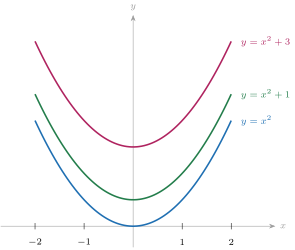
Reading a graph. The figure shows the curves of three antiderivatives of : , and . Adding a constant moves the whole curve up by : the curves of the antiderivatives of the same function are obtained from one another by a vertical shift. They never intersect.
We accept that every function continuous on an interval has antiderivatives on this interval. This is the case for all the functions in this chapter.