Planes and lines in space
Course · Mathematics (Grade 12 General Sciences, Lebanon), chapter 17 · Lebanon, Grade 12 General Sciences · the beginning of the chapter, the rest on Adloun
In the plane equipped with a coordinate system, a line can be described either by a single Cartesian equation (associated with a normal vector) or by a parametric representation (associated with a direction vector). In three-dimensional space, these two modes of description are shared between planes and lines: orthogonality to a single normal direction defines a plane, represented by one Cartesian equation , whereas collinearity with a single direction vector defines a line, represented by a system of three parametric equations or by the intersection of two intersecting planes.
This chapter establishes the Cartesian equations of planes in an orthonormal coordinate system — from a point and a normal vector, from three non-collinear points via the cross product, or from a point and two direction vectors via the scalar triple product — then the parametric and Cartesian representations of lines in space and the methods for going from one representation to the other.
Curriculum: LB-SG
Required skills
- Determine a Cartesian equation of a plane given a point and a normal vector, and read a normal vector from the Cartesian equation of a plane in an orthonormal coordinate system.
- Determine a Cartesian equation of a plane defined by three non-collinear points (using the cross product ) or by a point and two non-collinear direction vectors (using the scalar triple product).
- Write a parametric representation of a line in space defined by a point and a direction vector or by two distinct points.
- Characterize a line by a system of two Cartesian equations of intersecting planes, determine a direction vector of the intersection by the cross product , and go from a parametric representation to a Cartesian representation (and conversely).
17.1 Cartesian equation of a plane
Throughout this chapter, space is referred to a direct orthonormal coordinate system .
17.1.1 Characterizing a plane by a point and a normal vector
Let be a plane in space. A normal vector to the plane is any nonzero vector whose direction is perpendicular to , that is, any nonzero vector orthogonal to all the direction vectors of the plane .
Two normal vectors to the same plane are always collinear. If is a given point of space and a nonzero vector, there exists a unique plane passing through and having as a normal vector: it is the set of points of space such that the vectors and are orthogonal:
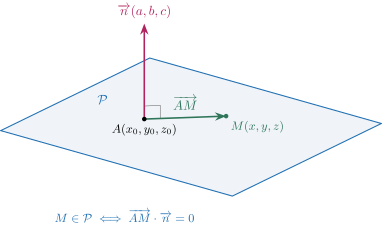
In space equipped with an orthonormal coordinate system :
- The plane passing through the point with normal vector is the set of points satisfying:
which is written in expanded form by setting .
- Conversely, for all real numbers such that , the set of points satisfying the equation:
is a plane of which the vector is a normal vector. This equation is called a Cartesian equation of the plane .
Proof
- Let be a point of space. The vector has coordinates . Since the coordinate system is orthonormal, the dot product is expressed by:
with .
- Conversely, assume , for example . The point satisfies , so . For every point :
where . The set of points is therefore the plane passing through with normal vector .
- Coordinate planes: the plane has normal vector and equation ; the plane has equation (normal vector ); the plane has equation (normal vector ).
- Plane parallel to a coordinate plane: an equation of the form () characterizes the plane parallel to passing through .
- Plane parallel to a coordinate axis: if one of the coefficients is zero, for example (), then the normal vector is orthogonal to : the plane is parallel to the axis (and contains if moreover ).
- Plane cutting the three axes away from the origin: if a plane cuts the axes , , at , and respectively, with , it has the intercept equation:
Exercises of the chapter
- Cartesian equation from a normal vector, perpendicular bisector plane and intercept equation solved
- Plane defined by three non-collinear points or by two direction vectors solved
- Parametric representation of a line, segment and traces on the coordinate planes solved
- Line defined by geometric conditions of parallelism or normality solved
- Line of intersection of two intersecting planes and conversion to parametric form solved
- From a parametric representation to a Cartesian system, and planes containing a line solved