Cross product and scalar triple product in space
Course · Mathematics (Grade 12 Life Sciences, Lebanon), chapter 13 · Lebanon, Grade 12 Life Sciences · the beginning of the chapter, the rest on Adloun
In rigid-body mechanics as in electromagnetism, the moment of a force about a point and the Lorentz force exerted by a magnetic field on a charged particle are both expressed by a fundamental geometric operation of three-dimensional space: the cross product. In analytic geometry, this tool makes it possible to construct a normal vector to a plane directly, to test whether three points are collinear and to compute the area of a triangle or of a parallelogram from the coordinates of their vertices alone.
By combining the cross product and the dot product, we obtain the scalar triple product of three vectors, whose analytic expression in a direct orthonormal coordinate system is a third-order determinant. This real number measures, up to sign, the volume of the parallelepiped built on the three vectors: it thus provides an immediate algebraic criterion for coplanarity and a direct formula for the volume of a parallelepiped or of a tetrahedron.
Curriculum: LB-SV
Required skills
- Determine the direction, the sense and the norm of the cross product in oriented space; compute its analytic components in a direct orthonormal basis .
- Use the cross product to characterize the collinearity of two vectors or of three points, and to determine a normal vector to a plane .
- Compute the area of a parallelogram and the area of a triangle , as well as the altitude of a triangle in space.
- Define the scalar triple product of three vectors, use its properties of antisymmetry and invariance under cyclic permutation, and compute it using a determinant.
- Characterize analytically the coplanarity of three vectors or of four points, and compute the volume of a parallelepiped and of a tetrahedron .
13.1 Components of the cross product
13.1.1 Review of the orientation of space and the geometric definition
A triple of non-coplanar vectors forms a basis of space. Space is oriented using the right-hand rule (three-finger rule, also called Ampère's rule): when the thumb of the right hand points in the direction of and the index finger in that of , the basis is called direct (right-handed) if the middle finger, bent perpendicular to the palm, points to the same side of the plane as , and indirect (left-handed) otherwise. A basis is called direct orthonormal if it is direct and made up of three pairwise orthogonal unit vectors:
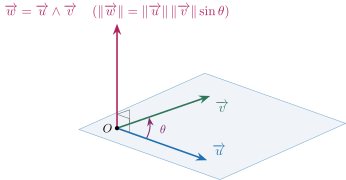
Let and be two vectors of oriented space. The cross product (or vector product) of and , denoted (read “ cross ”), is the vector defined as follows:
- if and are collinear, then ;
- if and are not collinear, then is the unique vector such that:
- Direction: is orthogonal to and to ( and ), hence normal to every plane spanned by ;
- Sense: the basis is direct;
- Norm: denoting by the unoriented geometric angle between and , we have:
For all vectors , , of space and all real numbers :
- Antisymmetry: , and in particular .
- Bilinearity:
- Lagrange's identity: .
- Vectors of a direct orthonormal basis :
13.1.2 Analytic components of the cross product
In space equipped with a direct orthonormal basis , let and be two vectors. The coordinates of their cross product are given by:
Proof
We decompose and . By bilinearity of the cross product, and since :
We recognize the three determinants of order extracted from the coordinate matrix .
Method : Practical layout for computing without sign errors
To compute the components of , write the two vectors as columns side by side. To obtain the th coordinate (), cross out the th row and compute the remaining determinant, assigning a sign to the first and third coordinates and a sign to the second coordinate (or copy the first row below the third so as to always read the cross products from top to bottom):
Systematic check: the vector found, , must satisfy and . Doing these two dot products mentally makes it possible to detect any calculation error instantly.
Exercises of the chapter
- Analytic computation of the cross product, Lagrange's identity and direct orthonormal basis solved
- Algebraic properties of the cross product and characterization of collinearity solved
- Normal vector, area of a triangle and distance from a point to a line solved
- Level sets and sets of points defined by a cross product solved
- determinant, orientation of a basis and coplanarity of four points solved
- Volume of a parallelepiped, volume of a tetrahedron and height from a vertex solved