Parallelism, orthogonality and distances in space
Course · Mathematics (Grade 12 Life Sciences, Lebanon), chapter 15 · Lebanon, Grade 12 Life Sciences · the beginning of the chapter, the rest on Adloun
In architecture, civil engineering or space robotics, it is not enough to describe planes and lines by their equations: we must be able to determine whether two walls are parallel or perpendicular, find the line of intersection of two roof slopes, check whether two straight pipes cross or are non-coplanar, and compute the minimum distance from a sensor to a flat wall or to a taut cable. In a direct orthonormal coordinate system of space, all these geometric questions translate directly into statements about the direction vectors of lines and the normal vectors of planes, using the dot product, the cross product and the scalar triple product.
- Study the relative position of two planes from their normal vectors and their Cartesian equations (parallel planes, coincident planes, planes intersecting in a line, perpendicular planes).
- Study the relative position of a line and a plane using a direction vector of the line and a normal vector of the plane (line parallel to the plane, contained in the plane, intersecting it, perpendicular to the plane).
- Study the relative position of two lines in space: coplanar lines (parallel or intersecting) or non-coplanar lines, using the scalar triple product; distinguish orthogonal lines from perpendicular lines.
- Determine the coordinates of the orthogonal projection of a point onto a plane and compute the distance from a point to a plane .
- Determine the orthogonal projection of a point onto a line and compute the distance from a point to a line using the orthogonal plane or the cross-product formula.
Throughout this chapter, the space is referred to a direct orthonormal coordinate system .
15.1 Relative positions of two planes
15.1.1 Parallel planes, coincident planes and intersecting planes
Let and be two planes of space, with respective normal vectors and , and with Cartesian equations:
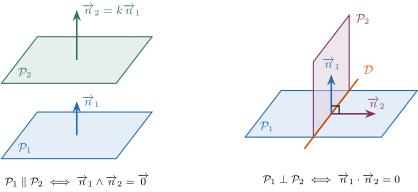
Since any direction orthogonal to a plane completely determines the orientation of that plane, the relative position of and depends on whether their normal vectors and are collinear.
Let and be two planes with respective normal vectors and .
- Parallel planes: and are parallel () if and only if their normal vectors and are collinear, that is, if there exists a nonzero real number such that (or equivalently ). In this case:
- if , the two equations are proportional and the planes and are coincident ();
- if , the planes and are strictly parallel ().
- Intersecting planes: and intersect if and only if the vectors and are not collinear (). Their intersection is then a line, a direction vector of which is the cross product:
Proof
- Two planes are parallel if and only if every line perpendicular to the first is also perpendicular to the second, which is equivalent to their normal vectors and being collinear. If with , then . The equation of can therefore be written , that is, . A point of satisfies ; it belongs to if and only if , that is, .
- If and are not collinear, the two planes are not parallel and intersect in a line . Every direction vector of lies both in the direction of and in that of : it is therefore orthogonal to and to . Now the cross product is nonzero and orthogonal to and to ; it is therefore a direction vector of the line of intersection .
15.1.2 Perpendicular planes
Two planes and , with respective normal vectors and , are said to be perpendicular (written ) when one of them contains a line perpendicular to the other, which is equivalent to their normal vectors being orthogonal.
Two planes and are perpendicular if and only if:
Method : Finding a parametric representation of the intersection of two intersecting planes
To find a parametric representation of the line when and are not collinear:
- Direct algebraic method: choose one of the three coordinates as the parameter (for example , with ) and solve the system of two equations in the two unknowns in terms of .
- Geometric method: compute the direction vector of , then find a particular point by fixing one of the coordinates (for example ).
Consider the planes and . Their normal vectors are and .
- We compute : the planes and are therefore perpendicular, and in particular they intersect in a line .
- Setting () in the system , we get from the second equation, then . A parametric representation of is therefore:
which passes through and has direction vector .
15.2 Relative positions of a line and a plane
15.2.1 Vector characterization using and
Let be a line passing through a point with nonzero direction vector , and a plane with Cartesian equation and normal vector .
The direction of the line is parallel to the plane if and only if the direction vector is orthogonal to the normal vector , which means that the dot product is zero.
- Line parallel to the plane (): the line is parallel to the plane () if and only if:
Two subcases then arise:
- if (that is, ), the line is contained in the plane ();
- if (that is, ), the line is strictly parallel to ().
- Line intersecting the plane (): if , the line and the plane intersect at a unique point ().
- Line orthogonal (or perpendicular) to the plane: the line is perpendicular to the plane () if and only if its direction vector is collinear with the normal vector of the plane (, that is, with ).
Exercises of the chapter
- Relative positions of two planes, perpendicular planes and line of intersection solved
- Relative positions of a line and a plane solved
- Coplanar or non-coplanar lines, orthogonal and perpendicular lines solved
- Orthogonal projection, reflection of a point in a plane and distance between parallel planes solved
- Locus of points equidistant from two intersecting planes and sphere tangent to a plane solved
- Orthogonal projection and distance from a point to a line by two methods solved