Logarithmic functions
Course · Mathematics (Grade 12 Sociology and Economics, Lebanon), chapter 2 · Lebanon, Grade 12 Sociology and Economics · the beginning of the chapter, the rest on Adloun
Objectives and required skills
- Know the definition of the natural logarithm function as the unique antiderivative of on that vanishes at , as well as the definition of the number .
- Master the fundamental algebraic properties of the logarithm (, , , ) and apply them to solve logarithmic equations and inequalities after studying the domain of validity.
- Know the direction of variation, the concavity and the representative curve of , the inequality and the reference limits (comparative growth at and at , difference quotient at ).
- Determine the domain, the limits and the derivative of a composite function .
Introduced at the beginning of the 17th century by the Scotsman John Napier to simplify astronomical calculations by turning multiplications into additions, the natural logarithm function holds a central place in analysis. From the point of view of integral calculus, it fills a notable gap in the table of antiderivatives of power functions: whereas for every integer the function has as an antiderivative on , the case (that is, the reciprocal function ) escapes this formula and leads us to define a new transcendental function.
2.1 The natural logarithm function
2.1.1 Existence, uniqueness and definition
The reciprocal function is continuous on the interval . By the fundamental theorem on the existence of antiderivatives of a function continuous on an interval, it has antiderivatives on , and exactly one of them takes the value at .
The natural logarithm function, denoted , is the unique antiderivative of the function on the interval that vanishes at . In other words:
- the domain of the function is ;
- the function is differentiable on and, for every real number ,
- .
For every real number , the real number (often written ) is read “natural logarithm of ”.
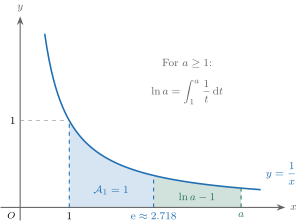
In an orthogonal coordinate system , since the function is continuous and positive on , for every real number , the number measures, in units of area, the area of the plane region bounded by the hyperbola with equation , the -axis and the vertical lines with equations and .
2.1.2 Immediate consequences and the number
- The function is continuous and strictly increasing on .
- For every real number , the sign of is given by the position of relative to :
- For all positive real numbers and :
Proof
- By definition, the function is differentiable on , so it is continuous on this interval. Moreover, for every , its derivative satisfies . The function is therefore strictly increasing on .
- Since and is strictly increasing on , the order is preserved: for , we have ; for , we have .
- A function that is strictly increasing on an interval preserves inequalities in both directions () and is injective ().
We assume for now (and will prove it when studying limits) that the function takes every real value on . The equation therefore has a unique solution in , which is denoted :
The number is an irrational (and even transcendental) number, whose decimal approximation to within is:
2.2 Algebraic properties
2.2.1 Functional equation and rules of computation
For all positive real numbers and , the logarithm of the product is equal to the sum of the logarithms:
Proof
Let be a fixed real number. Consider the function defined on the interval by:
The function is differentiable on and takes its values in since . By differentiating a composite function, the function is differentiable on and has derivative . Thus is differentiable on the interval and, for every :
Since its derivative is identically zero on the interval , the function is constant on . Now, at , we have . Consequently, for every real number , we have , that is, , hence .
For all positive real numbers and , and for every integer :
- Logarithm of a reciprocal: ;
- Logarithm of a quotient: ;
- Logarithm of a finite product: for all , ;
- Logarithm of an integer power: (in particular, );
- Logarithm of a square root: .
Exercises of the chapter
- Logarithmic equations, inequalities and systems: the domain-of-validity reflex solved
- Reference limits and comparative growth theorems solved
- Composite function with a logarithm, parity and oblique asymptote solved
- Synthesis problem: auxiliary function, implicit root and study of a logarithmic curve solved
- Logarithmic equations and inequalities solved
- Computing limits and comparative growth solved