Electrostatics
Course · Physics (Grade 10, Lebanon), chapter 1 · Lebanon, Grade 10 · the beginning of the chapter, the rest on Adloun
In winter, in dry weather, it is common to feel a small shock when touching the metal handle of a door, to hear slight crackling when taking off a wool sweater, or to see dry hair stand up as a plastic comb approaches. On a completely different scale, the lightning bolts that tear through the sky during a storm result from the same fundamental phenomenon: the accumulation and then the displacement of electric charges. Electrostatics is the branch of physics that studies the phenomena related to electric charges that are, on the whole, at rest (static), the ways they appear on materials and their mutual interactions.
Curriculum: LB-2
Required skills
- Distinguish the three modes of electrification: by friction, by contact and by induction.
- Show experimentally the existence of two kinds of electricity and state the qualitative law of electrostatic interactions.
- Interpret electrification phenomena at the microscopic scale by a transfer or a displacement of electrons, the atomic nucleus remaining unchanged.
- Distinguish an electric conductor from an electric insulator based on the mobility of electrons.
- Explain the operating principle of an electroscope and use it to detect the presence and the sign of an electric charge.
- Use the relation of quantization of electric charge with .
- Apply the principle of conservation of electric charge to an isolated system, in particular when conductors are brought into contact.
1.1 Electrification phenomena and the two kinds of electricity
1.1.1 Experimental evidence of electrification by friction
As early as Greek Antiquity, Thales of Miletus had observed that yellow amber (elektron in Greek), rubbed with a cat skin or a wool cloth, acquires the property of attracting very light bodies such as bits of straw, paper confetti or dust.
Let us carry out a simple experiment in the laboratory:
- Let us bring a plastic ruler (or an ebonite rod, or a PVC tube) close to small pieces of paper placed on a table: before any rubbing, nothing happens.
- Let us vigorously rub the end of the ruler with a dry wool cloth or a chamois leather, then bring it close to the confetti again without touching them: the small pieces of paper jump toward the ruler and stick to it.
- The same phenomenon is observed when a glass rod is rubbed with a silk or wool cloth.
A body that, after undergoing an action such as rubbing, acquires the property of attracting light bodies is said to be electrified (or charged with electricity). The physical quantity responsible for this state is called electric charge, denoted or .
Electrification by friction (or triboelectricity) is the appearance of electric charges on the surface of two initially neutral bodies when they are rubbed against each other.
1.1.2 The two kinds of electricity and their interactions
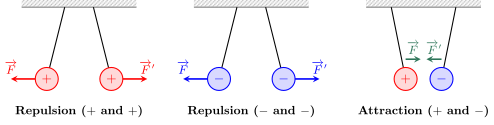
To study the mechanical actions exerted between two electrified bodies, electrified rods are suspended from insulating threads (or an electrostatic pendulum is used, made of a small light metallized polystyrene ball suspended from a silk thread).
- First observation: an ebonite rod (rubber hardened with sulfur) rubbed with fur repels a second ebonite rod also rubbed with fur.
- Second observation: a glass rod rubbed with a wool (or silk) cloth repels a second glass rod rubbed under the same conditions.
- Third observation: the rubbed glass rod and the rubbed ebonite rod attract each other.
Moreover, any other electrified body brought close to the setup behaves either like the rubbed glass (it repels the glass and attracts the ebonite), or like the rubbed ebonite (it repels the ebonite and attracts the glass). No electrified body repels both the rubbed glass and the rubbed ebonite.
There exist in nature two kinds of electricity (and only two), called by convention (introduced by Benjamin Franklin in the 18th century):
- Positive electric charges (): these are charges of the same nature as those that appear on glass rubbed with a wool or silk cloth (so-called “vitreous” electricity).
- Negative electric charges (): these are charges of the same nature as those that appear on ebonite, PVC or polystyrene rubbed with fur or wool (so-called “resinous” electricity).
Qualitative law of electrostatic interactions:
- Two bodies carrying electric charges of the same sign repel each other.
- Two bodies carrying electric charges of opposite signs attract each other.
1.2 Microscopic interpretation: electrons, insulators and conductors
1.2.1 Structure of the atom and transfer of electrons
To understand where the electric charges that appear during rubbing come from, we must look at the microscopic constitution of matter:
- All matter is made of atoms. Each atom consists of a central nucleus, very dense and positively charged (containing protons, which carry a positive charge, and electrically neutral neutrons), surrounded by a cloud of negatively charged electrons.
- In the normal state, an atom has as many electrons in its electron cloud as protons in its nucleus (atomic number ). The positive and negative charges exactly compensate each other: the atom — and consequently ordinary matter — is electrically neutral ().
- Protons are very strongly bound inside the atomic nucleus by the strong nuclear interaction: nuclei do not move and are never transferred during an electrification. On the other hand, the outermost electrons (peripheral electrons) are much less bound to the nucleus and can be pulled off one material to pass onto another.
Every electrification phenomenon of a solid body is explained exclusively by a transfer or a displacement of electrons:
- A body is negatively charged () if it has an excess of electrons compared with its neutral state.
- A body is positively charged () if it has a deficit of electrons (lack of electrons) compared with its neutral state.
Exercises of the chapter
- Series of interactions between pendulums and identification of the sign of the charges solved
- Electrification of an electroscope by contact and by induction with grounding solved
- Quantization of charge and sorting of physically possible values solved
- Electron balance and sharing of charge between two conducting spheres solved
- Cascades of contacts between four identical conducting spheres solved
- Electrical neutrality of matter and ionic charges in a crystal solved