Reflection and refraction of waves
Course · Physics (Grade 10, Lebanon), chapter 12 · Lebanon, Grade 10 · the beginning of the chapter, the rest on Adloun
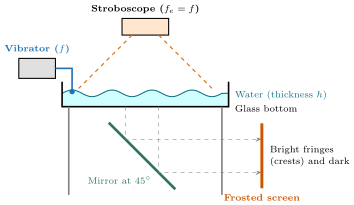
When a mechanical wave propagates on the surface of water or in an elastic medium, sooner or later it meets an obstacle, a rigid wall, a narrow opening or a change of medium (for example a sudden variation of the depth of the water). What then happens to its direction of propagation, its frequency, its speed of propagation and its wavelength? With a ripple tank lit with stroboscopic light, it is possible to visualize the crest lines on the surface of the water directly and to establish the geometric laws of the reflection and of the refraction of mechanical waves, as well as to observe their diffraction by a slit. These laws also make a remarkable experimental introduction to the behavior of light studied in the following chapters.
Curriculum: LB-2
Required skills
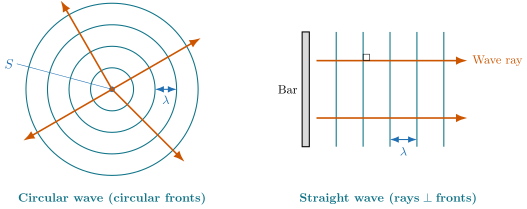
- Describe the ripple tank setup and define the notions of wave surface (or wavefront), crest line and wave ray (perpendicular to the wavefronts) for a circular wave and for a straight wave.
- State and apply the laws of reflection of a straight or circular mechanical wave on a plane obstacle (, conservation of , and ).
- Explain the phenomenon of refraction of a wave on the surface of water during a change of depth (conservation of the frequency , modification of the speed of propagation and of the wavelength ) and apply the Snell-Descartes law for waves: .
- Describe qualitatively the phenomenon of diffraction of a mechanical wave by an aperture of width of the order of magnitude of the wavelength .
12.1 Waves on the surface of water: ripple tank, wavefronts and wave rays
12.1.1 The ripple tank setup
The ripple tank is a rectangular basin with a flat, transparent glass bottom containing a thin layer of water of uniform thickness (a few millimeters to a few centimeters). A mechanical vibrator of adjustable frequency drives either a vertical point (which touches the water at a point and generates circular waves), or a flat horizontal bar (which strikes the water along a segment and generates straight waves). Lit from above by a stroboscope set to the frequency of the vibrator, the crests of the waves act like small converging lenses and project bright, motionless lines on a frosted screen, while the troughs project dark lines.
- A wave surface (or wave line in two dimensions, or else wavefront) is the set of points of the medium that are reached at the same instant by the wave and that vibrate in phase. In particular, each crest line is a wave line, and the perpendicular distance between two consecutive crest lines is equal to the wavelength .
- A wave ray is any oriented line that indicates locally the direction and the sense of propagation of the wave (and of the energy). In a homogeneous and isotropic medium, the wave rays are perpendicular to the wavefronts at every point:
- For a circular wave coming from a point source , the wavefronts are concentric circles of center spaced apart, and the wave rays are the half-lines coming from .
- For a straight wave created by a flat bar, the wavefronts are parallel line segments spaced apart, and the wave rays are straight lines parallel to one another and perpendicular to the wavefronts.
12.2 Reflection of a mechanical wave on a plane obstacle
12.2.1 Definition and conservation of the characteristic quantities
Let us place in the ripple tank a straight vertical metal barrier acting as a plane reflecting obstacle. When a train of incident straight waves meets this obstacle, it bounces off and leaves again in the same medium in a new direction: this is the phenomenon of reflection.
Since the reflection of a mechanical wave takes place in the same propagation medium, the reflected wave keeps exactly the same frequency , the same speed of propagation and the same wavelength as the incident wave:
Exercises of the chapter
- Reflection of a straight wave on the surface of a ripple tank solved
- Reflection of a circular wave on a plane wall and virtual source solved
- Echo from a wall and locating an obstacle by reflection solved
- Refraction of a straight wave when crossing a submerged step solved
- Refraction of an ultrasonic wave between water and a biological tissue solved
- Diffraction of mechanical waves on the surface of water and of sound waves solved