Description of motion
Course · Physics (Grade 10, Lebanon), chapter 7 · Lebanon, Grade 10 · the beginning of the chapter, the rest on Adloun
A passenger sitting in a bus traveling along a straight road is motionless relative to the vehicle, but in motion relative to the trees lining the roadway. How can we locate precisely the position of a moving object on a rectilinear trajectory at each instant, define its average speed and its instantaneous velocity from an experimental recording, and characterize the variation of this velocity by its acceleration? Such is the purpose of kinematics, the first part of mechanics, which studies the motion of bodies independently of the causes (forces) that produce it.
Curriculum: LB-2
Required skills
- Explain the relative character of motion and rest, define the trajectory of a moving object and choose a frame of reference provided with a space reference and a time reference.
- Locate the position of a moving object on an oriented rectilinear trajectory by its algebraic abscissa and its position vector , and carry out a change of origin .
- Define and calculate the average speed (in and in ).
- Determine the instantaneous velocity on a recording at regular time intervals , give the characteristics of the velocity vector and represent it to a chosen scale.
- Calculate the average acceleration and the instantaneous acceleration in a rectilinear motion.
- Give the characteristics of the acceleration vector and relate its direction (relative to the direction of motion) to the accelerated or decelerated nature of the rectilinear motion.
- Know the operating principle of the air table and use a recording of an air puck.
7.1 Rest and motion: relativity, trajectory and references
7.1.1 Relative character of motion and rest
A traveler sitting in a moving train is motionless relative to the car around him, but he is in motion relative to a person standing still on the station platform. Likewise, two cars traveling side by side on a straight highway at the same speed are at rest relative to each other, while being in motion relative to the road.
A body is in motion when it changes position over time relative to an object taken as reference. It is at rest if its position relative to this reference object remains unchanged over time.
The state of rest or of motion of a body therefore depends on the reference object chosen: motion and rest are relative.
7.1.2 Material point and trajectory
When the dimensions of a moving object are very small compared with the distances it travels (or when we follow a particular point of the object, such as its center of inertia ), we model the object by a geometric point called a point object (or material point).
The trajectory of a moving point is the geometric line formed by the set of successive positions occupied by this point during its motion:
- if this line is a straight line, the trajectory is rectilinear and the motion is said to be rectilinear;
- if this line is a curve (circle, arc of a parabola, any bend), the trajectory is curvilinear and the motion is said to be curvilinear.
Remark: Like the motion itself, the shape of the trajectory depends on the reference object chosen. Throughout the rest of this Grade 10 course, we will study only rectilinear motions.
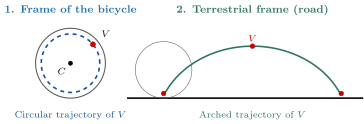
Example: the valve of a bicycle wheel rolling in a straight line describes a circle of center in the frame of reference attached to the bicycle frame, but a curve made of arches in the terrestrial frame of reference attached to the road.
7.1.3 Space reference on a rectilinear trajectory
To locate the position of a moving object that moves along a straight line, we provide this line with:
- a fixed point chosen as the origin of space;
- a positive direction (indicated by an arrow) and a unit of length (in the International System, the meter, symbol ), represented by a unit vector of magnitude .
We thus obtain an oriented axis , denoted , which constitutes the space reference. On this axis, the position of the moving object is located by a unique algebraic measure called the abscissa of the point :
- If is located on the side of the positive direction (direction of ) relative to , then ;
- if coincides with , then ;
- if is located on the side opposite to the positive direction relative to , then .
7.1.4 Frame of reference and time reference
- A frame of reference is the set formed by the reference object relative to which the motion is studied and the space reference attached to it. To study motions at the surface of the Earth (car on a road, falling ball, puck on a table), we use the terrestrial frame of reference, attached to the ground or to the laboratory table.
- A time reference is defined by the choice of an origin instant (), a direction of flow of time (from the past to the future) and a unit of duration (in the SI, the second, symbol ).
- An instant (or date) locates the moment when an event occurs ( after the time origin, before the time origin).
- A duration measures the time interval separating two instants and (, so ).
Exercises of the chapter
- Relativity of motion, choice of the frame of reference and change of origin on an axis solved
- Average speed over a rectilinear trip with a stop and unit conversions solved
- Time of inattention at the wheel and staggered arrival of two cars solved
- Representation of the velocity vector, calculation of average acceleration and nature of the motion solved
- Identifying the nature of a rectilinear motion from the vectors and solved
- Using a full-scale recording on an inclined air table solved