Force and resultant of forces
Course · Physics (Grade 10, Lebanon), chapter 9 · Lebanon, Grade 10 · the beginning of the chapter, the rest on Adloun
To set a body in motion, change the direction or the value of its velocity, keep it in equilibrium or deform it, a mechanical action must be exerted on it. In physics, any mechanical action exerted by an external system on a body is modeled by a vector quantity: the force vector. In reality, a solid is almost always subjected simultaneously to several concurrent forces (its weight, the tension of a cable, the reaction of a support, a driving force). In accordance with the official curriculum, this chapter briefly recalls the characterization of the force vector and the usual forces of mechanics, then develops in detail the geometric, trigonometric and analytical methods for determining the resultant of two or more concurrent forces as well as the resolution of a force in an orthonormal coordinate system.
Curriculum: LB-2
Required skills
- Characterize a force vector (point of application, line of action, direction, magnitude in newtons ) and represent the usual forces (weight , tension of a string or of a spring , reaction of a support ).
- Define the resultant of two concurrent forces and construct it geometrically by the parallelogram rule or the triangle rule.
- Calculate the magnitude and the orientation of the resultant of two forces making an angle with each other using the relation and deal with the special cases (, , ).
- Resolve a force along two perpendicular axes (in particular the weight on an inclined plane of angle ) and calculate the resultant of a system of several concurrent forces by the method of analytical projections.
9.1 Modeling a mechanical action by a force vector
9.1.1 Characteristics of the force vector
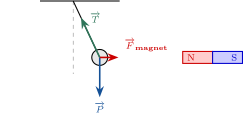
A mechanical action exerted by an agent on a receiver can produce dynamic effects (setting in motion or changing its velocity vector) and static effects (deforming or helping to keep it in equilibrium). We distinguish contact actions (localized at a point or distributed over a surface) and actions at a distance (gravitational, electric, magnetic).
Any force exerted on a material system is modeled by a bound vector characterized by four elements:
- Its point of application: the point of contact for a localized force, or the center of inertia (center of gravity) for a force distributed in volume such as the weight.
- Its line of action: the straight line along which the action is exerted (for example the vertical for the weight, the axis of the string for a tension).
- Its direction: that of the motion that the force tends to produce.
- Its magnitude (or intensity) : a positive quantity expressed in newtons (symbol ) in the International System, measurable with a dynamometer.
9.1.2 Review of the usual forces of mechanics
In high school mechanics problems, we mainly meet four fundamental forces:
- The weight of a body: gravitational attraction exerted by the Earth on a body of mass . It is applied at the center of gravity , along the vertical of the place, downward, and has the value:
with in kilograms (), in (or , ) and in newtons ().
- The tension of an inextensible string: contact force exerted by a taut string at the point of attachment, directed along the string and oriented from the body toward the string. If the string has negligible mass, its tension has the same magnitude at every point of the string (even if it passes over the groove of a frictionless pulley).
- The restoring force (or tension) of an elastic spring: for a spring of stiffness (in ) and natural length , stretched or compressed to the length , the magnitude of the tension is given by Hooke's law:
- The reaction of a support (horizontal or inclined plane): distributed contact force exerted by the support on the solid. It is always resolved into two perpendicular components:
where is the normal reaction (perpendicular to the support, directed toward the solid, which prevents it from sinking in) and is the friction force (parallel to the support and in the direction opposite to the sliding or to the tendency to slide). Since , the Pythagorean theorem gives:
In the absence of friction (perfectly smooth support), we have , so is perpendicular to the support.
Exercises of the chapter
- Resultant of two forces according to the angle between them solved
- Deflection pulley and resultant of two equal tensions solved
- Finding a component when the resultant is known solved
- Resolution of a pulling force and normal action of the ground solved
- Resolution of the forces on an inclined plane solved
- Resultant of three concurrent forces by the method of projections solved