Thin lenses and optical systems
Course · Physics (Grade 11, Lebanon), chapter 17 · Lebanon, Grade 11 · the beginning of the chapter, the rest on Adloun
From the corrective glasses worn by billions of people to the lenses of cameras and phone cameras, by way of the watchmaker's magnifying glass, the biologist's microscope, the classroom video projector and above all our own eye, all the optical instruments that form images rely on one fundamental component: the thin lens. By deviating light rays through refraction at its two curved faces, a converging or diverging lens concentrates or spreads light beams in a geometrically predictable way. This chapter studies the properties of spherical thin lenses (focal points, focal length, vergence — also called optical power — in diopters), the geometric construction and the algebraic calculation of the position and size of images, as well as the optical working of the human eye, the mechanism of accommodation and the correction of the three main defects of vision: myopia, hyperopia and presbyopia.
Curriculum: LB-1H
Required skills
- Distinguish by touch, by geometric shape and by optical behavior a converging lens (thin-edged, , ) from a diverging lens (thick-edged, , ), and use their standard symbols.
- Define the optical center , the principal optical axis , the principal object focal point and image focal point , the focal length and the vergence in diopters (), as well as the vergence of two lenses in contact .
- Construct geometrically the image of an object perpendicular to the optical axis using the three special rays, and state the characteristics of the image (real or virtual, upright or inverted, larger or smaller than the object).
- Apply the thin lens conjugation relation (or with the distances and ) and the magnification formula , in particular in the case of the magnifying glass.
- Describe the optical model of the reduced eye (diaphragm = iris/pupil, converging lens of variable focal length = cornea + crystalline lens, screen = retina), define accommodation, the punctum remotum (PR, far point) and the punctum proximum (PP, near point), and explain the origin and the optical correction of myopia, hyperopia and presbyopia.
17.1 Spherical thin lenses: focal points, focal length and vergence
17.1.1 Converging lenses and diverging lenses
A lens is a homogeneous transparent medium (mineral glass or organic polymer), of refractive index , bounded by two spherical surfaces (or one spherical surface and one plane surface). A lens is said to be thin when its thickness at the center is very small compared with the radii of curvature of its faces. Two families of lenses are distinguished:
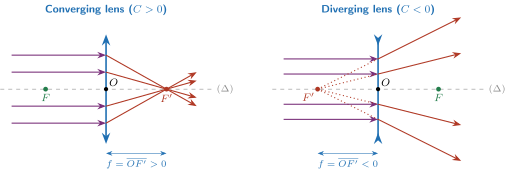
- Converging lenses (thin-edged): they are thicker at their center than at their edges (biconvex, plano-convex, converging meniscus). When they receive a beam of incident rays parallel to one another, they turn it into a converging emergent beam that narrows to a point. Placed near a printed text, they act as a magnifying glass and enlarge the letters.
- Diverging lenses (thick-edged): they are thinner at their center than at their edges (biconcave, plano-concave, diverging meniscus). When they receive a beam of parallel incident rays, they spread it into a diverging emergent beam. Placed near a text, they make the letters look smaller.
17.1.2 Optical center, principal focal points, focal length and vergence
The principal optical axis of the lens (the axis of symmetry perpendicular to the plane of the lens at its optical center ) is always oriented in the direction of propagation of the incident light (by convention, from left to right).
- Principal image focal point and principal object focal point :
- Every incident ray parallel to the principal optical axis emerges from the lens passing through the principal image focal point (for a converging lens, where lies after ) or seeming to come from (for a diverging lens, where lies before ).
- The principal object focal point is the reflection of through the optical center : . Every incident ray passing through (or heading toward ) emerges from the lens parallel to the optical axis .
- Algebraic focal length (often written ): it is the algebraic measure expressed in meters ():
- Vergence of a thin lens: it is the inverse of its algebraic focal length:
When is expressed in meters (), the vergence is expressed in diopters (symbol , with ): for a converging lens and for a diverging lens.
Exercises of the chapter
- Characterizing a set of lenses, focal points and the theorem of vergences solved
- Optical bench: how the real image changes as the object is brought closer to a converging lens solved
- Complete study of a botanist's magnifying glass solved
- Diverging lens: construction, calculations and comparison with a converging lens solved
- Study of a myopic eye and determination of the corrective lens solved
- Comparing hyperopia and presbyopia and calculating converging lenses solved