Work and mechanical energy
Course · Physics (Grade 12 General Sciences, Lebanon), chapter 1 · Lebanon, Grade 12 General Sciences · the beginning of the chapter, the rest on Adloun
A roller coaster car hauled up to the top of a ramp, an archer drawing the bow before releasing the arrow, a block compressing the spring of a railway buffer stop or the water held back behind the Qaraoun dam: in each of these situations, a material system stores a capacity to set itself in motion that depends only on its geometric configuration (height, extension of a spring, twist angle of a wire) and that can be converted wholly or partly into kinetic energy. Whereas the direct application of Newton's second law requires knowing, at every instant, the direction and sense of the forces and projecting vector relations, the energy approach links two states of a system directly through scalar quantities: the work of the forces, kinetic energy, potential energy and mechanical energy.
This chapter first consolidates the calculation of the work of a constant or variable force — establishing by integration the work of the tension of a spring — together with the kinetic energy theorem (in translation and in rotation). It then introduces the fundamental notion of a conservative force and the three forms of mechanical potential energy (gravitational, elastic in translation and elastic in torsion), and distinguishes the macroscopic mechanical energy from the microscopic internal energy within the principle of conservation of the total energy . After the study of energy diagrams and of how differential equations are obtained by differentiating with respect to time, the chapter applies the conservation of mechanical energy to fluids in steady flow (continuity equation, Bernoulli's theorem, Venturi tube, Torricelli's theorem, surface tension and viscosity).
Curriculum: LB-SG
Required skills
- Express and calculate the work of a constant force and the work of the weight for any displacement in a uniform gravitational field.
- Establish by integration the expression of the work of the elastic restoring force of a spring .
- Express the translational kinetic energy and the rotational kinetic energy of a rigid body about a fixed axis, and apply the kinetic energy theorem.
- Define a conservative force and relate its work to the change in the associated potential energy .
- State and use the expressions of the gravitational potential energy , of the elastic potential energy of a spring and of the torsional potential energy .
- Define the macroscopic mechanical energy , the microscopic internal energy and the total energy of a system; relate the non-conservation of in an isolated system to the change in internal energy (friction or chemical/nuclear reactions).
- Obtain the differential equation of motion of a conservative system with one degree of freedom by differentiating its mechanical energy with respect to time: .
- Interpret and use the energy diagrams , and (potential wells, equilibrium positions and bound states).
- Apply the laws of fluid statics and fluid dynamics: hydrostatic pressure , surface tension , continuity equation , Bernoulli's equation and viscous force .
1.1 Work of a force and the kinetic energy theorem
1.1.1 Review of the work of a constant force and of the work of the weight
When a force acts on a system whose point of application moves, it may favor this displacement, oppose it or have no energy effect on the magnitude of the velocity. Work is the algebraic measure of this transfer of mechanical energy along a given path.
- During an elementary (infinitesimal) displacement of its point of application, a force does the elementary work:
- If the force is constant in direction, sense and magnitude along a whole path leading from a point to a point , its work over the displacement is equal to the dot product of and the displacement vector :
where . In the International System, work is expressed in joules (, with ).
Depending on the value of the angle , the work is:
- driving () when : the force favors the displacement;
- zero () when : the force is at every instant perpendicular to the velocity vector (case of the normal reaction of a fixed frictionless support or of the tension of an inextensible string in a circular motion);
- resistive () when : the force opposes the displacement (case of a friction force constantly opposed to the motion, whose work is along a path of curvilinear length ).
Consider a body of mass and center of inertia moving from a position (at height ) to a position (at height ) in a uniform gravitational field , the axis being directed vertically upward (). The work of the weight does not depend on the path followed between and , but only on the difference in height :
In particular, the work of the weight is driving () during a descent () and resistive () during an ascent ().
Proof
In a coordinate system where is vertical and upward, we have and . Since the weight is a constant force, its work is:
1.1.2 Work of the elastic restoring force of a spring
Consider a helical spring with non-touching coils, of negligible mass and stiffness (in ), one end of which is fixed while the other is attached to a point object moving along the axis of the spring. The origin of the axis is chosen at the position occupied by the free end when the spring is at rest (neither stretched nor compressed).
When the free end has the algebraic abscissa (extension if , compression if ), the spring exerts on the object the elastic restoring force (or tension of the spring):
This force is not constant: its magnitude and its sense vary with the abscissa . To calculate its work between two abscissas and , the elementary works must be summed by integration.
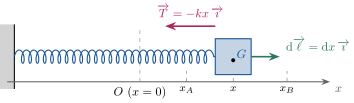
When the free end of a spring of stiffness goes from the abscissa to the abscissa (measured from the unstretched position ), the work of the restoring force depends only on the initial and final abscissas:
Proof
For an elementary displacement along the axis , the elementary work of the force is written:
Integrating this elementary work from the initial abscissa to the final abscissa , we obtain:
Similarly, when a rigid body rotating about a fixed axis is subjected to the elastic restoring couple of a torsion wire of torsion constant (in ), of moment , the elementary work is . For a rotation from the angular abscissa to the angular abscissa , the work of the torsion couple is:
1.1.3 Kinetic energy and the kinetic energy theorem
In a given frame of reference:
- The kinetic energy of a rigid body in translational motion, of mass , all of whose points move at every instant with the same speed , is:
- In the case of a rigid body rotating about a fixed axis with angular velocity (in ), each material point of mass located at the distance from the axis has a linear speed and a kinetic energy . The total kinetic energy of the body is then:
where (in ) is the moment of inertia of the body about the axis of rotation .
A homogeneous disk of mass and radius :
- slides without rolling in rectilinear translation at the speed : its translational kinetic energy is ;
- rotates about its fixed axis at the rotation frequency (taking ): its moment of inertia is , its angular velocity is , and its rotational kinetic energy is:
Exercises of the chapter
- Descent down an inclined plane followed by braking on a horizontal plane solved
- Work of the tension of a spring and launching of a puck solved
- Motion of a simple pendulum striking a nail solved
- Complete reading of an energy diagram solved
- Obtaining differential equations by differentiating the mechanical energy solved
- System coupling translation and rotation on an inclined plane solved