The atom and the quantization of energy
Course · Physics (Grade 12 General Sciences, Lebanon), chapter 11 · Lebanon, Grade 12 General Sciences · the beginning of the chapter, the rest on Adloun
When the light emitted by the incandescent filament of an ordinary lamp is dispersed with a prism or a grating, a continuous spectrum is observed, containing all the colors of the rainbow without interruption. On the other hand, the light emitted by a bulb containing an atomic gas at low pressure excited by an electric discharge (mercury, sodium or hydrogen vapor) contains only a small number of very narrow monochromatic radiations, separated by wide dark regions: it is a line spectrum, a true fingerprint of the chemical element. Why does an atom emit and absorb only certain strictly determined wavelengths? In 1913, the Danish physicist Niels Bohr solved this riddle by introducing the quantization of the energy levels of the atom, opening the way to modern quantum physics and to lasers.
Curriculum: LB-SG
Required skills
- Know the historical development of the models of the atom: Thomson's model (1897--1904), Millikan's measurement of the elementary charge (1909), Rutherford's -particle scattering experiment (1911, mostly empty structure and planetary model) and the modern quantum model of the electron cloud.
- Distinguish a continuous spectrum of thermal origin from a discontinuous atomic line spectrum (emission or absorption) and know that an atom can absorb only the radiations it is able to emit (examples of hydrogen, of the yellow sodium doublet and of the solar lines).
- State Bohr's postulates (stationarity of the quantized energy levels and energy transition relation ) and prove the expressions of the quantized radius () and of the energy () of the hydrogen atom.
- Use the energy-level diagram of the hydrogen atom: identify the ground state (), the excited states (), the ionized state (, ) and the ionization energy.
- Characterize the five spectral series of the hydrogen atom (Lyman in the UV, Balmer in the visible, Paschen, Brackett and Pfund in the IR), establish the Rydberg formula and calculate the extreme wavelengths ( and series limit ) of each series.
- Distinguish the conditions for exciting an atom by resonant absorption of a photon ( exactly, otherwise by photoionization if ) and by inelastic collision with an electron or another atom ().
- Know the properties of laser light (monochromaticity, coherence, directivity, high concentration of energy), explain the principle of stimulated emission, population inversion and optical pumping in a resonant cavity, and name the main types of lasers and their applications.
11.1 Historical models of the atom and atomic line spectra
11.1.1 From Thomson's model (1897--1904) to Rutherford's experiment (1911)
- Discovery of the electron (1897) and Millikan's experiment (1909): By studying the deflection of cathode rays by electric and magnetic fields in discharge tubes, the British physicist Joseph John Thomson discovered the electron in 1897, a negatively charged particle () present in all atoms, and determined the value of its charge-to-mass ratio . In 1909, the American Robert Millikan carried out his famous experiment with a charged oil drop in equilibrium between two horizontal plates and directly measured the elementary charge . From it, the mass of the electron is deduced, , about times smaller than that of the lightest atom (the hydrogen atom).
- Thomson's atomic model (1904, “plum pudding” or raisin cake): Since experiments in molecular physics had shown that atoms have a radius of the order of (), J. J. Thomson proposed in 1904 to represent the atom as a solid sphere of radius , filled with a positively charged substance holding almost all the atomic mass, and in which negative electrons are embedded (like raisins in a cake) whose total charge exactly compensates the positive charge so that the atom is electrically neutral.
In 1911, Ernest Rutherford (assisted by Hans Geiger and Ernest Marsden) put Thomson's model to a decisive experimental test by bombarding, in vacuum, a very thin gold foil (thickness of the order of , that is more than a thousand atomic layers) with a parallel monokinetic beam of particles (helium nuclei , of charge and mass greater than ) emitted by a radioactive radium source. The particles are detected by the tiny flashes of light (scintillations) they produce when they strike a circular screen coated with zinc sulfide ().
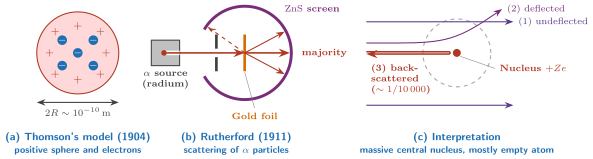
Rutherford's scattering experiment reveals three results incompatible with Thomson's solid model:
- The vast majority of the particles pass through the gold foil without any deflection (path 1): the atom is therefore made essentially of empty space (the mostly empty structure of matter).
- A few particles undergo a significant deflection when passing near the center of the atom (path 2) under the effect of an intense Coulomb repulsion.
- A very small number of particles (about in ) bounce backward with a deflection angle close to (path 3, backscattering).
In Thomson's model, where the positive charge was spread throughout the atomic sphere and the electrons were times lighter than the particles, the latter could never have bounced back (just as a stone thrown at high speed passes through a swarm of mosquitoes without being deflected). Rutherford concluded that all the positive charge and almost all the mass of the atom are concentrated in a tiny central nucleus (of radius to , that is to times smaller than the atom), around which the negative electrons orbit at a great distance like planets around the Sun (planetary model).
Modern quantum mechanics (de Broglie, Heisenberg, Schrödinger) has shown that on the subatomic scale it is impossible to assign a precise geometric path to the electron. The planetary model has now been replaced by the electron-cloud model: the electron is described by its probability of presence in each volume element surrounding the nucleus, this probability being maximum at a distance equal to the Bohr radius ( for the ground state of the hydrogen atom).
11.1.2 Continuous spectra and emission and absorption line spectra
Spectroscopic analysis of light with a prism or grating spectroscope makes it possible to classify light spectra into three main categories:
- Continuous emission spectrum (of thermal origin): a solid, a liquid or a gas at very high pressure brought to a high temperature (tungsten filament, surface of the Sun) emits polychromatic radiation whose spectrum is continuous (without a break from red to violet).
- Emission line spectrum: a monatomic gas at low pressure brought to a high temperature or subjected to an electric discharge (hydrogen spectral tube, sodium or mercury vapor lamp) emits light whose spectrum is discontinuous, made of narrow bright colored lines on a black background, each characterized by a precise wavelength .
- Absorption line spectrum: when a beam of white light (with a continuous spectrum) passes through a cold atomic gas at low pressure, the transmitted spectrum shows black lines on the colored continuous background.
At a given temperature, the black lines of the absorption spectrum of a gaseous chemical element occupy exactly the same wavelengths as bright lines of its emission spectrum: an atomic gas can absorb only the radiations it is able to emit. Each chemical element thus has a unique spectral signature that makes it possible to identify it from a distance (in particular in the atmosphere of stars).
Exercises of the chapter
- Energy-level diagram of hydrogen and Balmer series solved
- Comparing the Lyman, Balmer and Paschen series and Ritz combination principle solved
- Counting the emission lines after a selective excitation solved
- Excitation by photon versus excitation by electron collision on a cesium atom solved
- Hydrogen-like ions and : astrophysical spectroscopy solved
- Physical principle of the helium-neon laser () [LB-SG] solved