Radioactivity
Course · Physics (Grade 12 General Sciences, Lebanon), chapter 13 · Lebanon, Grade 12 General Sciences · the beginning of the chapter, the rest on Adloun
In March 1896, the French physicist Henri Becquerel discovered by chance that uranium salts fogged photographic plates wrapped in black paper, without having first been exposed to sunlight. A few years later, Pierre and Marie Curie isolated from pitchblende two new elements far more active than uranium — polonium and radium — and coined the term radioactivity. This phenomenon, which arises from the very heart of unstable atomic nuclei, is both a geological and archaeological clock of outstanding precision (carbon-14 dating) and an irreplaceable tool for diagnosis and therapy in nuclear medicine.
Curriculum: LB-SG
Required skills
- Define radioactivity (a spontaneous, random, inevitable nuclear transformation, independent of physical and chemical factors) and state Soddy's conservation laws (conservation of the mass number and of the charge number ).
- Identify and write the equations of the various modes of radioactive decay: (emission of a helium nucleus ), (emission of an electron and an antineutrino ), (emission of a positron and a neutrino ) and de-excitation.
- Calculate the energy released in a radioactive decay and interpret a nuclear energy diagram.
- Establish and use the radioactive decay law , define the radioactive constant , the radioactive period (or half-life) and the relation .
- Define and calculate the activity of a radioactive source in becquerels () and apply it to carbon-14 dating, nuclear medicine and radiation protection.
13.1 Unstable nuclei, Soddy's laws and types of radioactivity
13.1.1 Definition and general properties of radioactivity
Of the roughly three thousand known nuclides (natural or synthesized in the laboratory), fewer than three hundred are stable. All the others have an excess of nucleons, neutrons or protons that makes them unstable: sooner or later they turn into a more stable nucleus by emitting particles and electromagnetic radiation.
Radioactivity is the spontaneous nuclear transformation of an unstable atomic nucleus, called the parent nucleus (), into a more stable nucleus, called the daughter nucleus (), accompanied by the emission of one or more particles () and, most often, of electromagnetic radiation.
A radioactive decay has four fundamental characteristics:
- Spontaneous: it happens by itself, without any external intervention.
- Random (probabilistic): it is impossible to predict the precise instant at which a given individual nucleus will decay (a radioactive nucleus “does not age”: its probability of decaying in the next second stays the same whatever its age).
- Inevitable: every radioactive nucleus will sooner or later decay.
- Independent of physicochemical factors: it depends neither on temperature, nor on pressure, nor on the physical state (solid, liquid, gas), nor on the chemical or molecular species in which the atom is bound.
In any nuclear reaction (radioactive decay or induced nuclear reaction), the following are conserved:
- the total number of nucleons (conservation of the mass number );
- the total electric charge (conservation of the charge number ).
For a nuclear reaction with equation , Soddy's laws read:
- Natural radioactivity (1896--1898): discovered by Henri Becquerel in February–March 1896 in uranium salts, then studied by Pierre and Marie Curie, who isolated polonium () and radium () in 1898, it concerns the radioelements present in the Earth's crust or atmosphere ( and emitters).
- Artificial radioactivity (Irène and Frédéric Joliot-Curie, January 1934): by bombarding a boron target (or an aluminum target ) with particles () emitted by polonium, Irène and Frédéric Joliot-Curie synthesized the first artificial radioactive isotopes — nitrogen 13 (, half-life ) and phosphorus 30 (, half-life ) — which decay by emitting positrons ():
- Positron and neutrino: the positron (the antiparticle of the electron, predicted theoretically by P. Dirac in 1928 and observed in cosmic rays by C. Anderson in 1932) annihilates as soon as it meets an electron, giving two photons. As for the neutrino and the antineutrino (postulated by W. Pauli in 1930 and named by E. Fermi in 1934 to ensure the conservation of energy and momentum in decays), they are electrically neutral particles, of almost zero mass, moving at a speed very close to and interacting so weakly with matter that they can pass through a light-year of water () without undergoing a collision!
13.1.2 The various types of radioactive decay ()
Representing the nuclei on the Segrè chart (number of neutrons against number of protons ) makes it possible to visualize the valley of stability: for light nuclei (), the stable nuclei satisfy (the line ); for heavier nuclei (), the Coulomb repulsion between protons requires an excess of neutrons (, up to for lead, ). Depending on its position relative to the valley of stability, an unstable nucleus undergoes one of the following three decay modes:
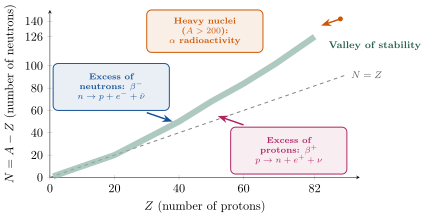
- radioactivity (nuclei that are too heavy, and ): the parent nucleus emits an particle, which is a very stable helium 4 nucleus () made of protons and neutrons:
Example: decay of radium 226 into radon 222: .
- radioactivity (nuclei with an excess of neutrons, located above the valley of stability): the parent nucleus emits an electron (called a particle) together with a neutral particle of almost zero mass called an antineutrino :
Nuclear mechanism: at the heart of the nucleus, an excess neutron turns into a proton according to ( is unchanged: an isobaric transformation, and increases by ). Example: carbon 14 () or cobalt 60 ().
- radioactivity (artificial nuclei with an excess of protons, located below the valley of stability): the parent nucleus emits a positron — the antiparticle of the electron, with the same mass and charge — together with a neutrino :
Nuclear mechanism: at the heart of the nucleus, an excess proton turns into a neutron according to ( is unchanged and decreases by ). Example: phosphorus 30 ().
- radiation (or de-excitation): after an or decay, the daughter nucleus is very often formed in an excited nuclear state, denoted . It returns almost instantaneously () to its ground state without changing its nature ( and unchanged) by emitting a very high-energy photon (of the order of an ) called radiation:
Exercises of the chapter
- Soddy's conservation laws, decay modes and the uranium 238 family solved
- Energy balance of an decay and recoil of the daughter nucleus solved
- Energy released in a decay from the binding energies solved
- Decay kinetics and thyroid scintigraphy with iodine 123 solved
- Carbon-14 dating of a Phoenician shipwreck solved
- Rubidium-strontium geological dating and the age of meteorites solved