Astronomy and the solar system
Course · Physics (Grade 12 Sociology and Economics, Literature and Humanities, Lebanon), chapter 5 · Lebanon, Grade 12 Sociology and Economics, Literature and Humanities · the beginning of the chapter, the rest on Adloun
Since Antiquity, the observation of the celestial vault and of the apparent motion of the heavenly bodies has guided the development of mechanics and of modern physics. From Ptolemy's geocentric model to the heliocentric revolution of Copernicus, from Kepler's three empirical laws of planetary orbits to Isaac Newton's law of universal gravitation, and on to stellar astrophysics and contemporary cosmology (the expansion of the Universe and the Big Bang model), this chapter of the Grade 12 curriculum of the Sociology and Economics and Literature and Humanities sections traces the architecture of the solar system, the evolution of stars and the history of the Universe.
Curriculum: LB-SE LB-LH
Required skills
- Distinguish the historical models of the Universe: the geocentric model (Aristotle, Ptolemy) and the heliocentric model (Copernicus, Galileo, Kepler).
- Describe the structure of the solar system: the Sun, the four terrestrial planets (Mercury, Venus, Earth, Mars), the asteroid belt, the four giant planets (Jupiter, Saturn, Uranus, Neptune), natural satellites, dwarf planets and comets.
- Use the astronomical units of distance: the astronomical unit () and the light-year ().
- State and use Kepler's three laws (law of elliptical orbits, law of areas, law of periods ) as well as Newton's law of universal gravitation ().
- Explain the motions of the Earth (daily rotation, annual revolution, tilt of the axis and the seasons) as well as the phases of the Moon and the mechanism of solar and lunar eclipses.
- Describe the birth, the thermonuclear energy source (fusion of hydrogen into helium) and the life cycle of a star according to its mass (red giant, white dwarf, supernova, neutron star, black hole).
- Know the large scales of the Universe (the Milky Way, galaxies), the Hubble-Lemaître law (redshift and expansion of the Universe) and the major arguments for the Big Bang model.
5.1 From geocentrism to heliocentrism and the structure of the solar system
5.1.1 Historical evolution of the representations of the world
The history of astronomy is marked by the gradual shift from a view centered on a motionless Earth to a physical description governed by universal laws:
- The geocentric model (Aristotle, 4th century BC; Claudius Ptolemy, 2nd century AD): the Earth is assumed to be spherical and motionless at the center of the Universe. The Moon, Mercury, Venus, the Sun, Mars, Jupiter, Saturn and the sphere of the fixed stars revolve around the Earth on combined circles (Ptolemy's epicycles and deferents, which account for the apparent retrograde motion of the planets).
- The heliocentric revolution (Nicolaus Copernicus, 1543): in his work De revolutionibus orbium coelestium, Copernicus places the Sun at the center of the planetary system. The Earth becomes one planet among others, with a twofold motion: a daily rotation about itself (in ) and an annual revolution around the Sun (in ).
- Galileo's decisive observations (1609--1610): by pointing an astronomical telescope at the sky for the first time, Galileo discovered the mountainous relief of the Moon, the four main satellites of Jupiter (Io, Europa, Ganymede, Callisto — proving that not all heavenly bodies revolve around the Earth) and the phases of Venus, which are incompatible with Ptolemy's system.
- The kinematic laws of Johannes Kepler (1609--1619) and the dynamical synthesis of Isaac Newton (1687): Kepler showed that planetary trajectories are not perfect circles but ellipses, and Newton proved that these trajectories follow from a single universal force of attraction: gravitation.
5.1.2 Architecture of the solar system: terrestrial planets and giant planets
The solar system, formed about billion years ago by the gravitational collapse of a giant molecular cloud (the protosolar nebula), consists of a central star — the Sun, which alone accounts for of the total mass of the system — and all the celestial bodies orbiting around it.
Moving away from the Sun, we successively encounter eight planets divided into two distinct families, separated by the main asteroid belt (located between Mars and Jupiter):
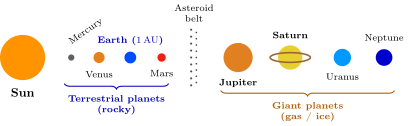
- The four terrestrial (inner) planets: Mercury, Venus, the Earth and Mars. Close to the Sun, they are small, of moderate mass but of high density ( to ). They have a solid rocky surface (silicates) surrounding a metallic core (iron, nickel), have few or no natural satellites ( for Mercury and Venus, for the Earth, for Mars: Phobos and Deimos) and have no ring system.
- The four giant (outer) planets: Jupiter, Saturn (gas giants rich in hydrogen and helium ) and Uranus, Neptune (ice giants rich in water, ammonia and methane). Far from the Sun, they have a very large diameter and a large mass but a low density ( to ; Saturn would float on water). They have no solid surface and are surrounded by rings and a very large number of natural satellites.
Beyond the orbit of Neptune lies the Kuiper belt, which is home to icy dwarf planets (such as Pluto and Eris) as well as small bodies, and then the distant Oort cloud, the reservoir of long-period comets. A comet is a small body made of a nucleus of ices and silicate dust (a “dirty snowball”) moving on a very elongated orbit; as it approaches the Sun, the sublimation of the ices and the pressure of the solar wind form its head (coma) and two tails (an ionized plasma tail and a dust tail), always pointing away from the Sun.
5.1.3 Astronomical units of distance
Since distances in the solar system and in the Universe are considerable, the meter or the kilometer are replaced by suitable units:
- The astronomical unit (), suited to distances within the solar system, is equal to the average distance between the center of the Earth and the center of the Sun:
- The light-year (), suited to interstellar and intergalactic distances, is the distance traveled by light in a vacuum () in one Julian year of days ():
- The parsec () and the megaparsec (), used in astrophysics and cosmology: the parsec is the distance between the Earth and a star from which the radius of the Earth's orbit around the Sun () is seen at an apparent angle (parallax) of one arcsecond ():
Since light travels at a finite speed , the light that reaches us from a heavenly body located at a distance has taken the time to reach us. Thus we see the Sun () as it was ago, the nearest star Proxima Centauri () as it was years ago, and the Andromeda galaxy () as it was million years ago.
Exercises of the chapter
- Historical models and classification of the planets of the solar system solved
- Astronomical unit, light-year and travel time of signals solved
- Using Kepler's three laws in the solar system solved
- Newton's law of universal gravitation and the Earth-Moon system solved
- Thermonuclear fusion, loss of mass of the Sun and the life cycle of stars solved
- Color of stars, the Milky Way and the scales of the Universe solved