English for Humanities (Grade 11, Lebanon) · Chapter 5 · Direct application of the course
Figures and a chart — Jacob Riis, “The Mixed Crowd”
Roots and Belonging: Explaining Who We Are · level 1 (application)
Statement
In Chapter 3 of How the Other Half Lives (1890), Riis describes the population of the tenements of lower New York. The “agent” is the person who collects the rents of a building.
When once I asked the agent of a notorious Fourth Ward alley how many people might be living in it I was told: One hundred and forty families, one hundred Irish, thirty-eight Italian, and two that spoke the German tongue. Barring the agent herself, there was not a native-born individual in the court. The answer was characteristic of the cosmopolitan character of lower New York, very nearly so of the whole of it, wherever it runs to alleys and courts. One may find for the asking an Italian, a German, a French, African, Spanish, Bohemian, Russian, Scandinavian, Jewish, and Chinese colony. Even the Arab, who peddles “holy earth” from the Battery as a direct importation from Jerusalem, has his exclusive preserves at the lower end of Washington Street.
A student has drawn this chart from the passage:
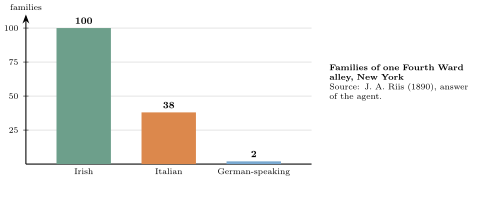
- What main idea does Riis want to establish? Quote the sentence that states it.
- Which figures does he give? Check that they are consistent, and say what the chart shows.
- Where do the figures come from? What are the limits of this source?
- By what other means does Riis develop his idea after the figures?
Solution
- That lower New York is a city of immigrants: “The answer was characteristic of the cosmopolitan character of lower New York”. Cosmopolitan means “made up of people from many countries”.
- “One hundred and forty families, one hundred Irish, thirty-eight Italian, and two that spoke the German tongue”: ; the figures are consistent. The chart shows that the Irish families are by far the most numerous (100 out of 140, about 71 percent), that the Italians are more than a quarter (38, about 27 percent) and that the German-speaking families are a tiny minority. It also shows, by what is absent, the fact that Riis adds: “there was not a native-born individual in the court”, except the agent.
- From an oral answer: “I asked the agent… I was told”. The agent knows her tenants, so the source is well placed; but the numbers are round (one hundred), given from memory, and concern one alley, chosen by Riis because it is “notorious”. One case does not measure a whole city: Riis himself says only that the answer is “characteristic”. The figures illustrate the idea; they do not prove it.
- By enumeration: “an Italian, a German, a French, African, Spanish, Bohemian, Russian, Scandinavian, Jewish, and Chinese colony” — ten names in a row, which give the impression of an endless variety; and by a particular example, “the Arab” of “the lower end of Washington Street”. That street was the home of the first immigrants from Mount Lebanon and Syria. Note the limits of Riis's authority here: he sees this community from outside, in one picturesque detail, and with the slightly mocking eye of his time.
Similar exercises
- Synthesis problem: Mary Antin and the making of an American solved
- Rhetorical devices — Gibran, “Yet I cannot tarry longer” solved
- How a portrait is developed — Mary Antin, The Promised Land solved
- Homesickness in a shop window — Claude McKay, “The Tropics in New York” solved
- Assessing sources for a project solved
The course of the chapter · All the exercises of the chapter