Life Sciences (Grade 10, Lebanon) · Chapter 4 · Direct application of the course
A reflex in an insect
Nervous communication · level 2
Statement
When the tip of a hind leg of a locust is pinched, it pulls the leg away at once. To look for the nerve center of this reflex, several experiments are carried out, each on a different locust. On the diagram, G, G and G are the three thoracic ganglia; N is the nerve that links ganglion G to the hind leg.
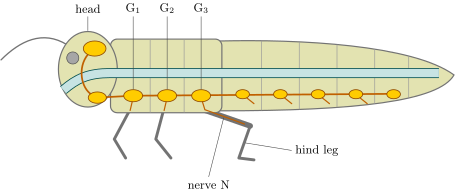
{
| No. | Intervention | Result of pinching the hind leg |
|---|---|---|
| 1 | none | withdrawal of the leg |
| 2 | the head is cut off | withdrawal of the leg |
| 3 | ganglion G is destroyed | no response |
| 4 | ganglion G is destroyed | withdrawal of the leg |
| 5 | nerve N is cut | no response |
- Specify the stimulus, the response and the effector of this reaction.
- Deduce from experiment 2 whether the cerebral ganglia are necessary for this reflex.
- Determine, using experiments 3 and 4, the nerve center of this reflex.
- Explain the result of experiment 5.
- Compare the path of the nerve message in this reflex with that of a flexion reflex in the frog.
Solution
- The stimulus is the pinching of the tip of the leg. The response is the withdrawal of the leg. The effectors are the muscles of the hind leg, which contract.
- The headless locust no longer has cerebral ganglia, and yet it pulls its leg away. The cerebral ganglia are therefore not necessary for this reflex.
- Destroying ganglion G removes the reflex, whereas destroying ganglion G leaves it intact. The nerve center of the withdrawal reflex of the hind leg is therefore the thoracic ganglion G, that is, the ganglion closest to this leg.
- Nerve N links the hind leg to ganglion G. Once this nerve is cut, the sensory message generated in the leg can no longer reach the nerve center, and no motor message can return to the muscles: the reflex disappears. Nerve N therefore conducts the nerve messages between the leg and the ganglion.
- In both cases, the message follows a reflex arc formed of the same elements: a sensory receptor, a sensory pathway, a nerve center, a motor pathway and an effector. In the frog, the nerve center is the spinal cord and the brain is not necessary; in the locust, the nerve center is a ganglion of the ventral nerve cord and the cerebral ganglia are not necessary.
Similar exercises
- The withdrawal reflex of the hand solved
- Labeling a neuron solved
- Labeling a section of spinal cord solved
- The response time of a spinal frog solved
- Curare, a poison of the synapse solved
The course of the chapter · All the exercises of the chapter