Life Sciences (Grade 10, Lebanon) · Chapter 4 · Direct application of the course
Curare, a poison of the synapse
Nervous communication · level 3 (hard)
Statement
Curare is a poison that peoples of the Amazon put on the tips of their arrows: the animal hit is paralyzed. In the middle of the 19th century, the physiologist Claude Bernard looked for what this poison acts on. He took from a frog a leg muscle with the nerve that goes to it, then set up this preparation in two ways. In each case, he stimulated either the nerve (stimulation S), or the muscle directly (stimulation S).
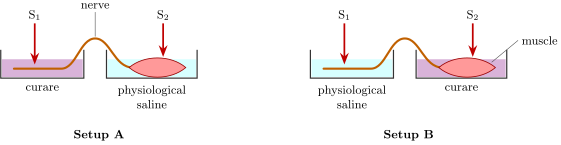
{
| Stimulation S of the nerve | Stimulation S of the muscle | |
|---|---|---|
| Setup A (only the nerve bathes in curare) | contraction of the muscle | contraction of the muscle |
| Setup B (only the muscle bathes in curare) | no contraction | contraction of the muscle |
- Show, using setup A, that curare does not prevent the nerve from conducting the nerve message.
- Show, using setup B, that curare does not prevent the muscle from contracting.
- In setup B, does the nerve message generated at S reach the end of the fibers of the nerve? Justify using question 1.
- Deduce from the previous answers where curare acts.
- It is now known that curare molecules bind to the receptors of the membrane of the muscle cell, in place of the neurotransmitter. Explain the paralysis, then.
- In an animal hit by a curare arrow, explain why the withdrawal reflexes disappear, whereas the sensory neurons and the spinal cord work normally.
Solution
- In setup A, the nerve bathes in curare. Yet stimulating it at S causes the muscle to contract: the nerve message has therefore traveled along the nerve to the muscle. Curare does not prevent the nerve fibers from conducting the message.
- In setup B, the muscle bathes in curare. Stimulated directly at S, it contracts: curare does not remove the ability of the muscle to contract.
- Yes. In setup B, the nerve does not even bathe in curare, and it has been seen that curare does not hinder conduction: the message generated at S travels normally along the fibers of the nerve to their ends, located in the muscle.
- In setup B, the message reaches the end of the nerve fibers and the muscle is able to contract; yet the muscle does not respond to the stimulation of the nerve. Curare therefore acts at the place where the message passes from the nerve to the muscle: the zone of contact between the end of the axon and the muscle cell, that is, the neuromuscular junction.
- At the neuromuscular junction, the end of the axon releases its neurotransmitter into the synaptic cleft. Normally, this neurotransmitter binds to the receptors of the muscle cell, which triggers contraction. If curare occupies these receptors, the neurotransmitter can no longer bind to them: the message is no longer transmitted to the muscle, which stays relaxed. All the muscles controlled by nerves are thus paralyzed.
- The withdrawal reflex requires the message to travel through the whole reflex arc, up to the effector. In the animal hit, the receptor, the sensory pathway, the nerve center and the motor pathway work, but the last synapse, between the motor neuron and the muscle, is blocked by curare. The muscle no longer receives the motor message: there is no longer any response, and therefore no longer any reflex.
Similar exercises
- The withdrawal reflex of the hand solved
- Labeling a neuron solved
- Labeling a section of spinal cord solved
- The response time of a spinal frog solved
- A reflex in an insect solved
The course of the chapter · All the exercises of the chapter