Life Sciences (Grade 10, Lebanon) · Chapter 4 · Direct application of the course
Labeling a neuron
Nervous communication · level 1 (application)
Statement
The following diagram represents a cell of the nervous system.
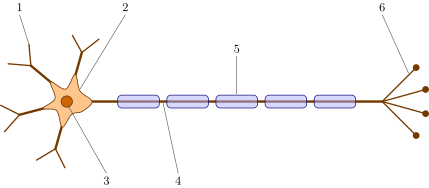
- Name this cell, then give the label corresponding to each of the numbers 1 to 6.
- Name the whole formed by elements 4 and 5.
- State in which part of the spinal cord elements 2 are found, and in which part mainly “4 and 5” wholes are found.
- Specify in which direction the nerve message travels through this cell when it transmits it to another cell, and justify the answer.
- On this diagram, the cell body is drawn to the scale “1 cm for ”. Calculate the length that the drawing of the axon would need, at the same scale, if this axon is 1 m long.
Solution
- This cell is a neuron. The labels are: 1, a dendrite; 2, the cell body; 3, the nucleus; 4, the axon; 5, the myelin sheath; 6, the axon terminals.
- The axon surrounded by its myelin sheath forms a nerve fiber.
- The cell bodies are found in the gray matter of the spinal cord. The nerve fibers make up most of the white matter.
- The nerve message goes from the dendrites and the cell body toward the axon terminals, following the axon. Indeed, it is the ends of the axon terminals that bear the presynaptic elements: only they contain the neurotransmitter vesicles capable of transmitting the message to the next cell.
- One meter equals . At the scale of 1 cm for , the length of the drawing would be:
A drawing 200 meters long would be needed: this shows why the proportions of a neuron cannot be respected on a diagram.
Similar exercises
- The withdrawal reflex of the hand solved
- Labeling a section of spinal cord solved
- The response time of a spinal frog solved
- A reflex in an insect solved
- Curare, a poison of the synapse solved
The course of the chapter · All the exercises of the chapter