Life Sciences (Grade 10, Lebanon) · Chapter 4 · Tutorial exercise
Loewi's two hearts
Nervous communication · B. From stimulus to response · level 2
Statement
In 1921, the physiologist Otto Loewi carried out an experiment that has become famous. He isolated two frog hearts, which keep beating for several hours in a physiological saline. Heart 1 kept a nerve, whose stimulation normally slows down the beats; heart 2 no longer has any nerve. Loewi stimulated the nerve of heart 1 for a few minutes, then collected the liquid bathing this heart and poured it onto heart 2.
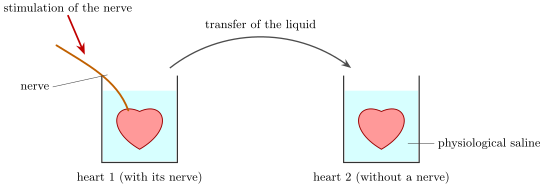
The table gives results of the kind obtained in this experiment (heart rate, in beats per minute).
| Step | Heart 1 | Heart 2 |
|---|---|---|
| A. Before any stimulation | 60 | 60 |
| B. During the stimulation of the nerve of heart 1 | 30 | 60 |
| C. After the transfer onto heart 2 of the liquid collected at step B | — | 36 |
| D. Control: transfer onto heart 2 of a liquid collected around heart 1 not stimulated | — | 60 |
- Describe the effect of the stimulation of the nerve on heart 1.
- Justify that heart 2 cannot receive any nerve message from heart 1.
- Describe the effect, on heart 2, of the liquid collected during the stimulation.
- Specify the purpose of step D.
- Deduce from these results what the liquid collected at step B contains and where this content comes from.
- Name, in general terms, a substance released by the end of a nerve fiber and acting on the neighboring cell.
- Relate this experiment to the functioning of a synapse.
Solution
- The stimulation of the nerve slows down heart 1: its rate goes from 60 to 30 beats per minute.
- Heart 2 is isolated in another container and no longer has any nerve: no nerve fiber links it to heart 1. Only the transferred liquid passes from one heart to the other.
- The liquid collected around heart 1 during the stimulation slows down heart 2: its rate goes from 60 to 36 beats per minute.
- Step D is a control. It shows that the liquid collected around a heart whose nerve is not stimulated does not change the rate of heart 2. The slowing down at step C is therefore due neither to the transfer itself nor to the physiological saline, but to something that appears in the liquid only when the nerve is stimulated.
- The liquid collected at step B contains a chemical substance capable of slowing down a heart. This substance is present only if the nerve has been stimulated: it was released by the ends of the fibers of the nerve, in contact with heart 1, then it diffused into the liquid.
- Such a substance is a neurotransmitter.
- At a synapse, the nerve message does not pass directly from one cell to the other. The presynaptic element, that is, the end of the axon, releases a neurotransmitter into the synaptic cleft; this neurotransmitter acts on the postsynaptic cell. Loewi's experiment shows it: the action of the nerve on the heart takes place through a chemical substance, which can be collected and carried in a liquid.
What the exercise establishes: the transmission of the nerve message to the next cell is chemical: it takes place through a neurotransmitter.
Similar exercises
- The nervous system of the earthworm solved
- Where are the cell bodies of the fibers of a nerve? solved
- Five experiments on a spinal frog solved
- Finding the cut root solved
- The withdrawal reflex of the hand solved
The course of the chapter · All the exercises of the chapter