Life Sciences (Grade 10, Lebanon) · Chapter 4 · Tutorial exercise
The nervous system of the earthworm
Nervous communication · A. Organization of the nervous system · level 2
Statement
The earthworm is an invertebrate whose body is formed of a series of rings. The diagram represents the front part of its body, seen from the side, after a dissection.
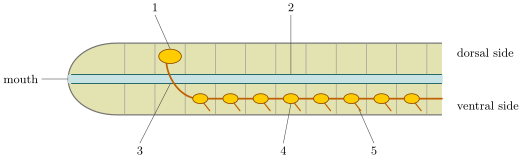
The labels are given in random order: nerve ring, ganglion of the nerve cord, cerebral ganglia, nerve, digestive tract.
- Match each label with its number.
- Name the whole formed by the series of ganglia 4 and specify its position relative to the digestive tract.
- Find, on the diagram, the number of ganglia of this cord per ring of the body.
- Give two differences between the nervous system of the earthworm and that of a vertebrate such as the frog.
- Give one feature common to both nervous systems.
Solution
- The labels are: 1, the cerebral ganglia; 2, the digestive tract; 3, the nerve ring; 4, a ganglion of the nerve cord; 5, a nerve.
- The series of ganglia 4, linked to one another, forms the ventral nerve cord. It is located below the digestive tract, on the ventral side.
- From the fourth ring onward, each ring of the body contains one ganglion of the nerve cord.
- First difference: the nerve centers of the earthworm are ganglia mostly placed in a ventral position, below the digestive tract, whereas those of the frog (brain and spinal cord) are in a dorsal position. Second difference: the nerve centers of the earthworm are protected by no bony skeleton, whereas those of the frog are enclosed in the skull and the vertebral column.
- In both cases, the nervous system comprises nerve centers and nerves that link these centers to the organs of the body.
What the exercise establishes: the plan of organization of the nervous system of an invertebrate, compared with that of a vertebrate.
Similar exercises
- Labeling the nervous system of the frog solved
- Where are the cell bodies of the fibers of a nerve? solved
- Five experiments on a spinal frog solved
- Finding the cut root solved
- Loewi's two hearts solved
The course of the chapter · All the exercises of the chapter