Life Sciences (Grade 10, Lebanon) · Chapter 4 · Tutorial exercise
The withdrawal reflex of the hand
Nervous communication · B. From stimulus to response · level 3 (hard)
Statement
While taking the bread off the saj, someone accidentally touches the scorching plate: the hand pulls away at once.
Part A. The scene is filmed, then the person is questioned. The film shows that the withdrawal movement begins a fraction of a second after the contact. The person states that they did not decide to pull their hand away and that they felt the burn only once the hand had been pulled away.
Part B. The table summarizes what is observed in three people, each suffering from a different injury, when their hand touches a scorching object.
| Person | Injury | Withdrawal of the hand | Sensation of burning |
|---|---|---|---|
| 1 | cut of the nerve serving the hand and the forearm | no | no |
| 2 | cut of the spinal cord above the region from which the nerves of the arm leave | yes | no |
| 3 | destruction of the dorsal roots of the spinal nerves of the arm | no | no |
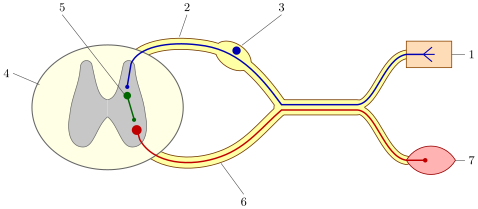
Part C. The diagram represents the path of the nerve message during this reflex.
- Find, in Part A, two arguments showing that this withdrawal is a reflex.
- Specify, for this reflex, the stimulus, the organ that bears the sensory receptors and the effector.
- Explain, using person 1, the role of the nerve.
- Deduce from the case of person 2 the nerve center of this reflex and the organ necessary for the sensation of burning.
- Explain, using person 3, where the sensory message enters the spinal cord.
- Give the label corresponding to each of the numbers 1 to 7 of the diagram.
- State the number of synapses the message crosses between the skin and the muscle, locating them.
- A toxic substance prevents the vesicles of the synapse located between the motor neuron and the muscle from releasing their content. Predict, explaining it, its effect on the withdrawal reflex.
- Write a short text that describes the path of the nerve message from the skin to the muscle, and that explains why this message cannot travel this path in the reverse direction.
Solution
- First argument: the person did not decide to pull their hand away, so the movement is involuntary. Second argument: the withdrawal begins a fraction of a second after the contact, even before the burn is felt; it is therefore very fast. An involuntary and fast response to a stimulus is a reflex.
- The stimulus is the heat of the plate. The sensory receptors are in the skin of the hand. The effectors are the muscles of the arm, whose contraction moves the hand away.
- In person 1, the skin, the spinal cord and the muscles are intact, but the nerve is cut: there is neither withdrawal nor sensation. The nerve is therefore the essential conductor of nerve messages between the hand and the nerve centers.
- In person 2, the part of the spinal cord from which the nerves of the arm leave is intact, but it is no longer linked to the brain. The withdrawal of the hand persists: the nerve center of this reflex is therefore the spinal cord, and the brain is not necessary for it. On the other hand, the burn is no longer felt: the sensation requires messages to reach the brain.
- In person 3, only the dorsal roots are destroyed; the nerve, the spinal cord and the ventral roots are intact. There is no longer either withdrawal or sensation: the sensory message coming from the skin no longer reaches the spinal cord. This message therefore enters the spinal cord through the dorsal roots, which are sensory.
- The labels are: 1, the sensory receptor (in the skin); 2, the fiber of the sensory neuron (in the dorsal root); 3, the spinal ganglion, which contains the cell body of the sensory neuron; 4, the spinal cord (nerve center); 5, the association neuron; 6, the fiber of the motor neuron (in the ventral root); 7, the muscle (effector).
- The message crosses three synapses: the first between the sensory neuron and the association neuron, the second between the association neuron and the motor neuron, both in the gray matter of the spinal cord; the third between the motor neuron and the muscle (neuromuscular junction).
- At the neuromuscular junction, the motor nerve message is transmitted to the muscle only if the vesicles at the end of the axon release their neurotransmitter into the synaptic cleft. If this release is prevented, no neurotransmitter binds to the receptors of the muscle cell: the muscle no longer receives any order and does not contract. The withdrawal reflex disappears, although the message reaches the end of the motor neuron normally.
- The heat stimulates sensory receptors in the skin, where a sensory nerve message arises. This message travels along the fiber of a sensory neuron, in the nerve then in the dorsal root, and reaches the gray matter of the spinal cord. There it is transmitted to an association neuron, then to a motor neuron. The motor nerve message leaves the spinal cord through the ventral root, follows the nerve and reaches the muscle, which contracts. At each passage from one cell to the next, the message crosses a synapse: the presynaptic element releases a neurotransmitter that binds to the receptors of the postsynaptic element. Since only the presynaptic element contains vesicles of neurotransmitter and only the postsynaptic element bears the receptors, transmission can take place in only one direction: the message always goes from the receptor to the effector, never the reverse.
What the exercise establishes: bring together in a single line of reasoning the reflex, its arc, the role of the nerve centers and the one-way direction imposed by the synapses.
Similar exercises
- The nervous system of the earthworm solved
- Where are the cell bodies of the fibers of a nerve? solved
- Five experiments on a spinal frog solved
- Finding the cut root solved
- Loewi's two hearts solved
The course of the chapter · All the exercises of the chapter