Life Sciences (Grade 11, Lebanon) · Chapter 1 · Direct application of the course
From the chromosome to the DNA molecule
DNA, genetic information and the cell cycle · level 1 (application)
Statement
Diagram a shows a chromosome observed during mitosis; diagram b shows, laid flat, a very short fragment of the molecule that makes it up. Three bases have been replaced by a question mark.
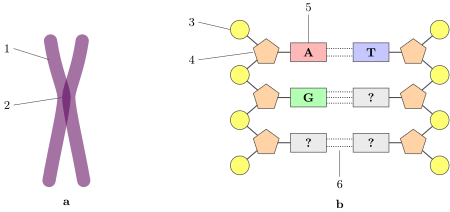
- Give the labels corresponding to numbers 1 and 2 of diagram a.
- Give the labels corresponding to numbers 3 to 6 of diagram b.
- Name the unit formed by elements 3, 4 and 5.
- Replace each question mark with the appropriate letter, knowing that the third pair has a thymine on the left.
- State how many DNA molecules the chromosome of diagram a contains, with justification.
- Name the other chemical constituent of a chromosome.
Solution
- 1: a chromatid; 2: the centromere.
- 3: a phosphate group; 4: the sugar, deoxyribose; 5: a nitrogenous base, here adenine; 6: weak bonds (hydrogen bonds) between two complementary bases.
- A phosphate, a deoxyribose and a base form a nucleotide.
- In the second pair, guanine G faces cytosine C. In the third pair, thymine T, on the left, faces adenine A, on the right. The number of bonds drawn can be checked: three between G and C, two between T and A.
- This chromosome is made of two chromatids. Each chromatid contains one DNA molecule: the chromosome therefore contains two DNA molecules, which are identical since they result from the replication of the same molecule.
- A chromosome also contains proteins, around which the DNA molecule coils.
Similar exercises
- The Meselson and Stahl experiment solved
- The number of chromosomes of some species solved
- Dolly the sheep solved
- Counting cells to measure durations solved
- Mice that received a fragment of rat DNA solved
The course of the chapter · All the exercises of the chapter