Life Sciences (Grade 11, Lebanon) · Chapter 1 · Tutorial exercise
Putting the images of a mitosis back in order
DNA, genetic information and the cell cycle · A. Nucleus, chromosomes and mitosis · level 2
Statement
Diagrams A, B, C and D show, in random order, four moments of the mitosis of an animal cell. The thin lines represent the spindle fibers.
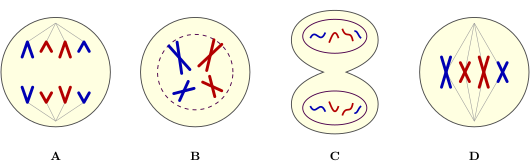
- Name the phase of mitosis shown by each of the diagrams.
- Arrange the four diagrams in chronological order.
- State the number of chromosomes of this cell and write its chromosome set.
- Specify, for diagram B and then for diagram A, how many chromatids each chromosome is made of.
- Count the chromosomes present in each of the two nuclei of diagram C, then conclude.
Solution
- Diagram A shows two sets of chromosomes moving away toward the poles: this is anaphase. Diagram B shows condensed chromosomes, scattered inside a nuclear envelope that is disappearing: this is prophase. Diagram C shows two re-formed nuclei and a cell that is pinching in two: this is telophase. Diagram D shows chromosomes lined up at the equator of the cell: this is metaphase.
- The chronological order is: B (prophase), D (metaphase), A (anaphase), C (telophase).
- Diagrams B and D show four chromosomes, grouped in two pairs (two large, two small). The chromosome set is .
- In diagram B, each chromosome is made of two chromatids joined by the centromere. In diagram A, the chromatids have separated: each moving chromosome is made of a single chromatid.
- Each nucleus of diagram C contains four chromosomes: two large and two small, like the starting cell. Each of the two daughter cells therefore receives the same number of chromosomes as the parent cell and the same karyotype: mitosis has divided the chromosomal set equally.
What the exercise establishes: recognizing each phase from the arrangement of the chromosomes and checking that mitosis conserves the karyotype.
Similar exercises
- The karyotype of the fruit fly solved
- Acetabularia grafts solved
- Counting the bases of a DNA molecule solved
- In search of the transforming principle solved
- The quantity of DNA over successive divisions solved
The course of the chapter · All the exercises of the chapter