Life Sciences (Grade 12 Life Sciences, Lebanon) · Chapter 1 · Tutorial exercise
Mitosis or meiosis? Two curves to tell apart
Sexual reproduction: meiosis, gametogenesis and fertilization · A. Diploid and haploid cells, meiosis: counting chromosomes, chromatids and DNA · level 2
Statement
The quantity of DNA per cell is followed over time in two cells of the same male mouse: a cell X taken from the bone marrow and a cell Y taken from the wall of a seminiferous tubule. Each curve follows one cell, then one of the cells derived from it. The quantities are given in arbitrary units (a.u.).
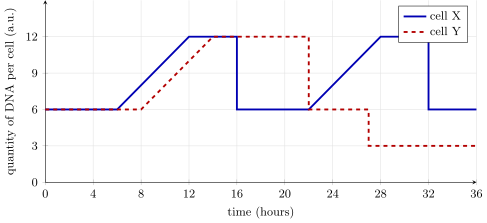
The time scale is schematic: in the animal, a meiosis lasts much longer than a mitosis.
- Give the quantity of DNA of each cell at time 0, then at 15 hours.
- Name the phenomenon that takes place in cell X between 6 and 12 hours and state its consequence for each chromosome.
- Describe the variation observed for cell X at 16 hours and at 32 hours and interpret it.
- Deduce the type of division undergone by cell X. Justify with the quantity of DNA of the cells formed.
- Describe the variations of the curve of cell Y after 14 hours.
- Point out the difference between the two curves that shows that cell Y undergoes a meiosis.
- Give the chromosome set ( or ) and the number of chromatids per chromosome of the cell followed on curve Y at 10 hours, 18 hours, 25 hours and 30 hours.
- Name the cell followed on curve Y at 18 hours, at 25 hours and at 30 hours.
Solution
- At time 0, both cells contain 6 a.u. of DNA. At 15 hours, both contain 12 a.u.
- Between 6 and 12 hours, the quantity of DNA of cell X doubles progressively, from 6 to 12 a.u.: this is DNA replication (S phase). Each chromosome goes from one chromatid to two identical chromatids.
- At 16 hours and again at 32 hours, the quantity of DNA per cell falls abruptly from 12 to 6 a.u.: the cell divides and its DNA is shared equally between the two daughter cells.
- Cell X undergoes mitoses: each division is preceded by a replication, and the cells formed have the same quantity of DNA (6 a.u.) as the starting cell. Two successive cell cycles are seen.
- After the replication (8 to 14 hours), the quantity stays at 12 a.u. until 22 hours, then falls to 6 a.u.; it stays at 6 a.u. from 22 to 27 hours, then falls again, to 3 a.u., and stays at that value.
- For cell Y, two successive halvings (at 22 hours and at 27 hours) follow a single replication, and there is no replication between them: the final quantity (3 a.u.) is half that of the starting cell (6 a.u.). This is the signature of meiosis; cell X, on the contrary, replicates its DNA before every division.
- At 10 hours: , replication in progress (some chromosomes already have two chromatids). At 18 hours: , two chromatids per chromosome. At 25 hours: , two chromatids per chromosome. At 30 hours: , one chromatid per chromosome.
- At 18 hours: a primary spermatocyte. At 25 hours: a secondary spermatocyte. At 30 hours: a spermatid.
What the exercise establishes: distinguishing mitosis from meiosis on a curve — one replication for one division, or one replication for two divisions.
Similar exercises
- Somatic cell or gamete? solved
- Putting the images of a meiosis back in order solved
- Why is this mouse sterile? solved
- The interrupted meiosis of the oocyte solved
- Counting gametes solved
The course of the chapter · All the exercises of the chapter