Life Sciences (Grade 12 Life Sciences, Lebanon) · Chapter 1 · Tutorial exercise
Putting the images of a meiosis back in order
Sexual reproduction: meiosis, gametogenesis and fertilization · A. Diploid and haploid cells, meiosis: counting chromosomes, chromatids and DNA · level 2
Statement
Diagrams A to E show, in random order, five moments of the meiosis of the same animal cell. The thin lines are spindle fibers. The chromosomes of paternal origin are drawn in blue, those of maternal origin in red.
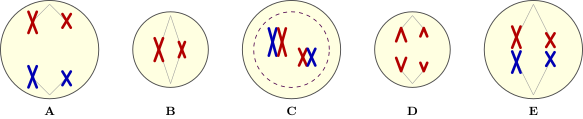
- Determine the chromosome set of this cell, using diagram C.
- Name the structures formed by the chromosomes in diagram C and say how many there are.
- Identify the phase shown by each diagram, with one justification for each.
- Put the five diagrams in chronological order.
- Diagrams B and D each show only one of the two cells present at that moment. Give the colors of the chromosomes of the other cell.
- Compare what separates in diagram A with what separates in diagram D.
- Give the number of chromosomes and of chromatids in each cell formed at the end of this meiosis.
Solution
- Diagram C shows four chromosomes, each with two chromatids: two large ones and two small ones. So and .
- In C, the homologous chromosomes are paired: each pair forms a bivalent, or tetrad (four chromatids). There are two bivalents.
- C: the chromosomes are condensed and paired inside a nuclear envelope that is disappearing: prophase I. E: the two bivalents are at the equator, the homologues on either side of the equatorial plane: metaphase I. A: two-chromatid chromosomes move toward the poles, one of each pair per pole: anaphase I. B: a cell with only two two-chromatid chromosomes, not paired, lined up at the equator: metaphase II. D: single-chromatid chromosomes move toward the poles, two per pole: anaphase II.
- The order is C, E, A, B, D.
- At anaphase I (diagram A), the upper pole receives the two red chromosomes and the lower pole the two blue ones. Cells B and D show the red chromosomes: the other cell contains one large blue chromosome and one small blue chromosome.
- In A, the two homologous chromosomes of each pair separate, and each keeps its two chromatids: the chromosome number is halved. In D, the two chromatids of each chromosome separate: the number of chromosomes per cell does not change.
- Each of the four cells has 2 chromosomes, each with a single chromatid, that is, 2 chromatids: it is haploid, .
What the exercise establishes: recognizing the phases of the two divisions of meiosis and justifying each one by the chromosomes, their chromatids and their position.
Similar exercises
- Somatic cell or gamete? solved
- Mitosis or meiosis? Two curves to tell apart solved
- Why is this mouse sterile? solved
- The interrupted meiosis of the oocyte solved
- Counting gametes solved
The course of the chapter · All the exercises of the chapter