Life Sciences (Grade 12 Life Sciences, Lebanon) · Chapter 1 · Direct application of the course
The quantity of DNA from the oocyte to the embryo
Sexual reproduction: meiosis, gametogenesis and fertilization · level 2
Statement
The graph shows the quantity of DNA in the nucleus (or nuclei) of a female germ cell of a mammal, then of the cell that results from its fertilization. The arrow marks the entry of the spermatozoon.
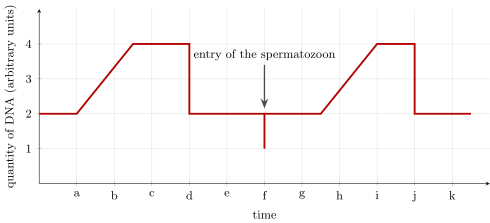
At the moment marked by the arrow, two events follow each other within a short time: the quantity of DNA of the female nucleus falls from 2 to 1, then the total quantity of DNA of the cell is again 2.
- Name the phenomenon that takes place between a and c (rise from 2 to 4).
- Interpret the fall observed at d.
- Name the cell between d and f and give its chromosome set and the number of chromatids of its chromosomes.
- Interpret the fall from 2 to 1 that follows the entry of the spermatozoon.
- Explain why the total quantity of DNA of the cell is again 2 just afterward.
- Interpret the variations observed from g to j, and name the division that takes place at j.
- Indicate, on the time axis, the haploid phase and the beginning of the diploid phase of the new generation.
Solution
- The quantity of DNA doubles: it is the DNA replication that precedes meiosis. The cell, a primary oocyte, then has two-chromatid chromosomes.
- At d the quantity is halved (4 to 2): the first division of meiosis is completed. The homologous chromosomes have been shared between the secondary oocyte and the first polar body.
- It is a secondary oocyte: haploid (), with two-chromatid chromosomes, blocked in metaphase II.
- The entry of the spermatozoon triggers the end of the second division of meiosis: the chromatids separate, one set stays in the cell and the other leaves in the second polar body. The female nucleus is now haploid with single-chromatid chromosomes (quantity 1).
- The nucleus of the spermatozoon, also haploid with single-chromatid chromosomes, brings a quantity 1. The cell now contains the DNA of the two nuclei, : their union gives the diploid nucleus of the fertilized egg.
- From g to i, the quantity doubles (2 to 4): the fertilized egg replicates its DNA. At j, it is halved (4 to 2) and returns to the value of a diploid cell: the egg divides by mitosis, the first division of the embryo.
- The haploid phase goes from d (end of the first division) to the union of the two nuclei, just after f. The diploid phase of the new generation begins with the fertilized egg, from the union of the nuclei onward.
Similar exercises
- Chromosome sets from one generation to the next solved
- Three anaphases to tell apart solved
- The two functions of the testis solved
- Another life cycle solved
- Girl or boy? solved
The course of the chapter · All the exercises of the chapter