Life Sciences (Grade 12 Life Sciences, Lebanon) · Chapter 1 · Direct application of the course
Three anaphases to tell apart
Sexual reproduction: meiosis, gametogenesis and fertilization · level 2
Statement
Diagrams 1, 2 and 3 show three cells of the same animal, taken from two different organs, each fixed during an anaphase.
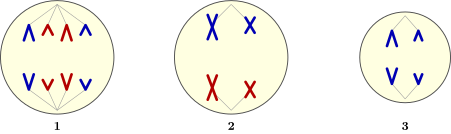
- Count, in each diagram, the chromosomes that move toward each pole and say whether they have one or two chromatids.
- Identify the anaphase shown by diagram 2, with justification.
- Identify the anaphases shown by diagrams 1 and 3, with justification.
- Deduce the chromosome set of this animal.
- Indicate the organ from which each cell may have been taken.
- Give the chromosome set of the cells that will be formed from each of the three cells.
Solution
- Diagram 1: four single-chromatid chromosomes per pole. Diagram 2: two two-chromatid chromosomes per pole. Diagram 3: two single-chromatid chromosomes per pole.
- In diagram 2 the chromosomes that move apart still have their two chromatids, and each pole receives one large and one small chromosome, that is, one chromosome of each pair: the homologous chromosomes are separating. It is anaphase I of meiosis.
- In diagram 1, chromatids separate and each pole receives four chromosomes, among which two large (one blue, one red) and two small: the homologues are present together in each set, so the set stays diploid. It is the anaphase of a mitosis. In diagram 3, chromatids also separate, but each pole receives only two chromosomes, one large and one small, with no homologue: the cell was already haploid. It is anaphase II of meiosis.
- A diploid set has four chromosomes (diagram 1): .
- Cells 2 and 3 are in meiosis: they come from a gonad (testis or ovary). Cell 1, in mitosis, can come from any organ whose cells divide, for example the skin or the bone marrow; it could also be a spermatogonium of the testis.
- Cell 1 gives two diploid cells (). Cell 2 gives two haploid cells () with two-chromatid chromosomes. Cell 3 gives two haploid cells () with single-chromatid chromosomes.
Similar exercises
- Chromosome sets from one generation to the next solved
- The quantity of DNA from the oocyte to the embryo solved
- The two functions of the testis solved
- Another life cycle solved
- Girl or boy? solved
The course of the chapter · All the exercises of the chapter