Life Sciences (Grade 12 Life Sciences, Lebanon) · Chapter 10 · Direct application of the course
Reading a recording
Functioning of neurons · level 1 (application)
Statement
A microelectrode is inserted into a nerve fiber at time ms; the fiber is stimulated at ms with a shock above the threshold. The recording obtained is shown below.
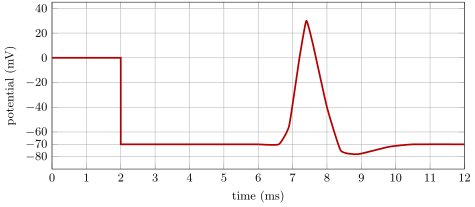
- Give the value of the potential between 0 and 2 ms and explain it.
- Name the potential recorded between 2 and 6 ms, give its value and state what it shows about the membrane.
- Name the signal recorded from 6.6 ms on and give its amplitude.
- Name the successive phases of this signal and give the value reached at the end of each.
- Explain the delay of 0.6 ms between the stimulation and the beginning of the signal.
- Predict the recording if the intensity of the stimulation were doubled, with justification.
Solution
- 0 mV: the two electrodes are in the extracellular fluid, and there is no potential difference between two points of the same medium.
- It is the resting potential, mV: the membrane is polarized, its inner face being negative with respect to its outer face.
- It is an action potential. Its amplitude is the difference between the peak and the resting potential: mV.
- Depolarization, up to mV; repolarization, back to mV; hyperpolarization, down to mV; then return to the resting potential.
- The action potential arises at the stimulating electrodes and must travel to the recording electrode: the delay is the time of this propagation.
- The recording would be identical: according to the all-or-none law, the amplitude of the action potential of a fiber does not depend on the intensity of the stimulus once the threshold is reached.
Similar exercises
- A fiber, then a nerve solved
- Conduction velocity of two fibers solved
- The poison of the puffer fish solved
- Two presynaptic neurons solved
- Two pains after one prick solved
The course of the chapter · All the exercises of the chapter