Life Sciences (Grade 12 Life Sciences, Lebanon) · Chapter 10 · Direct application of the course
The pump and the poison
Functioning of neurons · level 3 (hard)
Statement
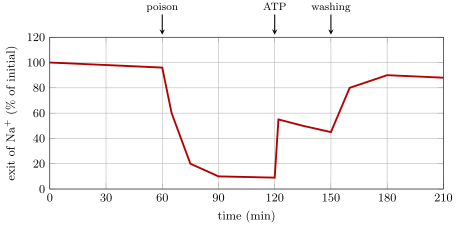
A giant axon of squid is loaded with radioactive sodium, then placed in a large volume of seawater that is renewed regularly. The radioactivity that leaves the axon each minute measures the exit of . At 60 min, a poison that blocks the production of ATP by the mitochondria is added to the seawater; at 120 min, ATP is injected into the axon; at 150 min, the poison is washed out. The resting potential is measured at the same time (illustrative data, on the model of classic experiments).
{
| Time (min) | 0 | 60 | 120 | 150 | 210 |
|---|---|---|---|---|---|
| Resting potential (mV) |
- Describe the evolution of the exit of between 0 and 120 min.
- Deduce the nature of the transport that expels . Justify.
- Explain the effect of the injection of ATP, and that of washing out the poison.
- Name the membrane protein responsible for this exit of , and state its other role.
- The resting potential hardly changes during the experiment. Explain why this result does not contradict the role of the pump in the resting potential. (Help: during one hour, only a tiny fraction of the ions contained in such a large axon cross the membrane.)
- Predict what would happen to the resting potential of a small neuron poisoned for a long time. Justify.
Solution
- From 0 to 60 min, the exit of is high and almost constant (100 then 96%). After the poison is added, it falls quickly, to 10% at 90 min, and stays at this low level until 120 min.
- The exit of stops when the cell can no longer produce ATP: it requires energy. is moreover expelled against its concentration gradient (it is more concentrated outside). It is therefore an active transport, which consumes ATP.
- ATP injected directly into the axon partly restores the exit of (55%, then about 45 to 50%), although the poison is still present: the poison acts only by depriving the transport of ATP, and ATP is the source of energy used. When the poison is washed out, the cell produces its own ATP again, and the exit returns close to its initial value (about 90%).
- The / pump, which uses the energy of one ATP to expel three and to bring in two : it maintains the unequal distribution of ions on which the resting potential depends.
- The resting potential results from the unequal distribution of ions and from the permeability of the membrane to . When the pump stops, the ions leak slowly through the channels; in a large axon, the quantities that cross the membrane in one hour are tiny compared with the stocks: the concentrations, and thus the resting potential, hardly change in the short term. The pump does not create the resting potential directly; it maintains its conditions in the long run.
- In a small neuron, the stocks of ions are much smaller with respect to the surface of the membrane. Poisoned for a long time, its concentrations of and would slowly even out on both sides of the membrane, and the resting potential would decrease, then disappear: the neuron would no longer be excitable.
Similar exercises
- A fiber, then a nerve solved
- Conduction velocity of two fibers solved
- The poison of the puffer fish solved
- Two presynaptic neurons solved
- Two pains after one prick solved
The course of the chapter · All the exercises of the chapter