Life Sciences (Grade 12 Life Sciences, Lebanon) · Chapter 10 · Tutorial exercise
Two currents for one action potential
Functioning of neurons · A. Resting potential, action potential and nerve impulse · level 2
Statement
A technique makes it possible to hold the membrane of an axon at a chosen potential and to measure the current of ions that crosses it. The membrane is suddenly brought from −70 mV to 0 mV and held there for 4 ms. By convention, an entry of positive charges is counted negatively, an exit positively (curves constructed after the classic experiments on the giant axon of the squid; arbitrary units).
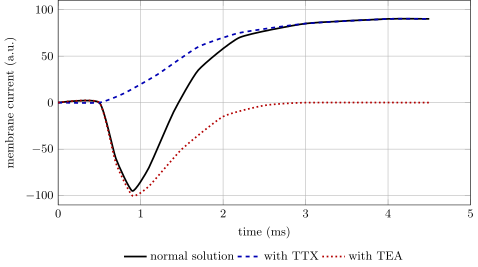
The depolarization is applied at 0.5 ms.
- Describe the current recorded in the normal solution.
- Describe the current that remains in the presence of TTX, and deduce the current that TTX suppresses.
- Describe the current that remains in the presence of TEA, and deduce the current that TEA suppresses.
- Identify the ion that carries the early inward current and the ion that carries the late outward current, with justification.
- Deduce the target of TTX and that of TEA.
- Relate each of the two currents to a phase of the action potential.
- Explain why the inward current stops after about 2 ms although the membrane is still depolarized.
Solution
- In the normal solution, the current is first inward (negative), with a maximum of −95 a.u. at 0.9 ms, then reverses around 1.5 ms and becomes outward, reaching +90 a.u. at 4 ms.
- With TTX, only an outward current remains, which rises slowly to +90 a.u. TTX suppresses the early inward current.
- With TEA, only an inward current remains: it reaches −100 a.u. at 0.9 ms and returns to zero around 2.5 to 3 ms. TEA suppresses the late outward current.
- An inward current of positive charges can only be carried by an ion that is more concentrated outside: . An outward current of positive charges is carried by an ion that is more concentrated inside: .
- TTX blocks the voltage-gated channels; TEA blocks the voltage-gated channels.
- The early entry of corresponds to the depolarization phase; the delayed exit of corresponds to the repolarization phase.
- The voltage-gated channels open quickly when the membrane is depolarized, then close spontaneously within about a millisecond and become inactive, even if the depolarization lasts. This inactivation limits the duration of the depolarization phase and explains the refractory period.
What the exercise establishes: separating the sodium and potassium currents of the action potential with two blockers.
Similar exercises
- Potassium and the resting potential solved
- Conduction along a nerve solved
- A receptor that codes for pressure solved
- Crossing the synapse solved
- Adding and subtracting solved
The course of the chapter · All the exercises of the chapter