Life Sciences (Grade 12 Life Sciences, Lebanon) · Chapter 5 · Tutorial exercise
Reading an antibody
Self, non-self and immunocompetence · B. The cells, the organs and the receptors of immunity · level 2
Statement
The diagram shows a molecule of antibody directed against a toxin, T1. Two test tubes each receive these antibodies; toxin T1 is added to the first, another toxin, T2, to the second. A complex of antibodies and toxin forms in the first tube only.
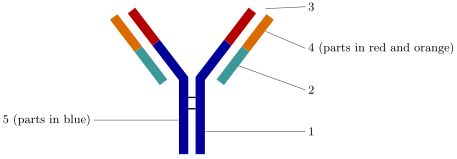
- Name the elements numbered 1 to 5.
- Give the number of chains of this molecule and state which are identical.
- Give the number of binding sites and state which parts of the chains form each of them.
- Explain why the antibody binds T1 and not T2.
- Name the small part of the toxin to which the binding site attaches.
- Compare the regions 4 and 5 of this antibody with those of an antibody directed against T2.
- State the two forms in which this molecule exists in the organism, and the cells concerned.
- Explain how, with its two sites, an antibody can link microbes or molecules into clumps.
Solution
- 1: heavy chain. 2: light chain. 3: antigen-binding site. 4: variable regions. 5: constant regions.
- Four chains: two heavy chains, identical to each other, and two light chains, identical to each other.
- Two binding sites, identical, one at the tip of each arm of the Y. Each is formed by the variable region of one heavy chain together with the variable region of one light chain.
- The binding site has a shape complementary to that of one part of toxin T1, and fits it. Toxin T2 has a different shape, which does not fit this site: the recognition is specific.
- An antigenic determinant.
- The constant regions (5) are the same in the two antibodies. The variable regions (4) are different: their sequence of amino acids, and therefore the shape of the binding site, is proper to each antibody.
- Set in the membrane of a B lymphocyte, where it is the receptor of this cell for the antigen; and free in the body fluids, after secretion by plasma cells, which derive from B lymphocytes.
- Each of the two sites can bind one antigen: one antibody can hold two molecules of toxin, or two microbes, at once. If each antigen carries several determinants, the antibodies link them step by step into a network, a clump. This is what happens in the agglutination of red blood cells.
What the exercise establishes: the structure of an antibody, and the link between its variable regions and the specificity of the recognition of an antigen.
Similar exercises
- Four bloods to identify solved
- Blood groups in a family solved
- Where do lymphocytes come from? solved
- What does a T lymphocyte recognize? solved
- Finding a donor for Sami solved
The course of the chapter · All the exercises of the chapter