Life Sciences (Grade 12 Life Sciences, Lebanon) · Chapter 6 · Direct application of the course
Mice without a thymus
The stages of the immune response · level 2
Statement
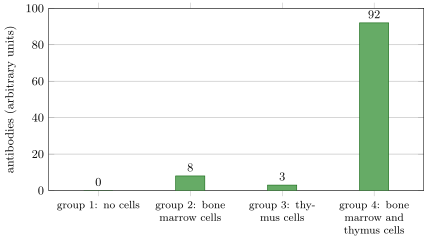
Mice of the same strain are thymectomized at birth, then irradiated as adults: irradiation destroys the cells of their bone marrow and their lymphocytes. Four groups then receive different cells from healthy mice of the same strain. All the mice are given an antigen, sheep red blood cells. One week later, the antibodies against sheep red blood cells are measured in their serum (constructed data).
- Explain the purpose of the thymectomy and of the irradiation.
- Indicate which lymphocytes are supplied by the bone marrow cells in a thymectomized mouse, and which by the thymus cells.
- Compare the results of groups 2, 3 and 4.
- Show that the result of group 4 is not the simple sum of those of groups 2 and 3, and conclude.
- Name the cells that secrete the antibodies and the cells from which they derive.
- Explain how the other population of lymphocytes takes part in this production.
Solution
- Irradiation destroys the lymphocytes and the bone marrow cells that produce them; thymectomy prevents any new T lymphocyte from maturing. The mice have no lymphocytes left: the only ones they will have are those supplied by the experimenter.
- Bone marrow cells give B lymphocytes, which mature in the bone marrow; without a thymus, they cannot give mature T lymphocytes. Thymus cells supply T lymphocytes.
- With bone marrow cells alone, the production is very low (8 a.u.); with thymus cells alone, it is almost zero (3 a.u.); with both, it is high (92 a.u.).
- The sum of groups 2 and 3 would be a.u., whereas group 4 reaches 92 a.u., about eight times more. The two populations do not simply add their effects: they cooperate. A normal antibody production requires both B lymphocytes and T lymphocytes.
- The antibodies are secreted by plasma cells, which derive from B lymphocytes selected by the antigen.
- T4 lymphocytes, activated by antigen-presenting cells, become T helper lymphocytes and secrete interleukins. These messengers stimulate the multiplication of the selected B lymphocytes and their differentiation into plasma cells. Without them (group 2), the B lymphocytes hardly respond.
Similar exercises
- A wound and its phagocytes solved
- Serum or lymphocytes? solved
- Two injections of the same toxoid solved
- Reading an immunodiffusion plate solved
- Three doses of a vaccine solved
The course of the chapter · All the exercises of the chapter