Life Sciences (Grade 12 Life Sciences, Lebanon) · Chapter 6 · Tutorial exercise
Target cells and killer lymphocytes
The stages of the immune response · B. Cooperation and effectors of the specific response · level 2
Statement
Mice of strain H are infected with a virus F. Eight days later, their T8 lymphocytes are purified. Target cells are loaded with a radioactive substance that leaves the cell only when the cell is destroyed; the radioactivity released into the medium therefore measures the destruction of the targets. The graph gives the percentage of radioactivity released after four hours, for five kinds of target cells.
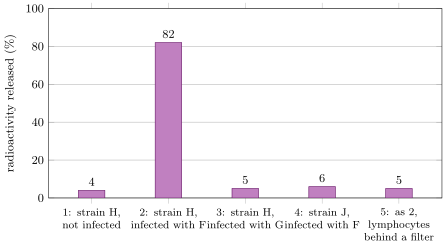
Strain J differs from strain H in its MHC molecules (the equivalent in the mouse of the human HLA molecules). In test 5, the lymphocytes are separated from the target cells by a filter that lets molecules through but not cells.
- Explain why the radioactivity released measures the destruction of the target cells.
- Compare tests 1 and 2, then conclude.
- Deduce from tests 2 and 3 a property of these lymphocytes.
- Interpret the result of test 4.
- Interpret the result of test 5.
- Describe the mechanism by which the target cell is destroyed.
- Explain the advantage, for the body, of destroying its own infected cells.
Solution
- The radioactive substance stays inside an intact cell and escapes only when the membrane is damaged. The more targets are destroyed, the more radioactivity is found in the medium.
- Non-infected cells of strain H are spared (4%), whereas cells of the same strain infected with F are largely destroyed (82%). The T8 lymphocytes of the infected mouse have become cytotoxic T lymphocytes, which destroy the infected cells and not the healthy ones.
- Cells infected with another virus, G, are spared (5%). The cytotoxic T lymphocytes are specific to the virus that induced them.
- Cells of strain J infected with the same virus F are spared (6%). The lymphocytes of strain H do not recognize the viral peptide when it is presented by MHC molecules other than their own. The T-cell receptor recognizes the viral peptide together with a class I MHC molecule of the self: a dual recognition.
- When the lymphocytes cannot touch the targets, there is no destruction (5%), although molecules can pass through the filter. The cytotoxicity is not due to a substance released at a distance: it requires contact between the lymphocyte and its target.
- The cytotoxic T lymphocyte binds to the infected cell by its T-cell receptor, then releases at the point of contact the content of its granules: perforin, which forms channels in the membrane of the target, and enzymes that enter through these channels and trigger the death of the cell. The lymphocyte detaches, intact.
- A virus multiplies only inside cells, where antibodies cannot reach it. By destroying the infected cells, the body removes the factories that produce the virus; the viruses released are then neutralized by antibodies and eliminated by phagocytes.
What the exercise establishes: establishing the specificity, the MHC restriction and the contact dependence of cytotoxic T lymphocytes.
Similar exercises
- Two ways of transferring an immunity solved
- Are the clones there before the antigen? solved
- T4 lymphocytes and their messenger solved
- A toxin, antibodies and red blood cells solved
- Ten days with a respiratory virus solved
The course of the chapter · All the exercises of the chapter