Life Sciences (Grade 12 Life Sciences, Lebanon) · Chapter 6 · Tutorial exercise
Ten days with a respiratory virus
The stages of the immune response · B. Cooperation and effectors of the specific response · level 3 (hard)
Statement
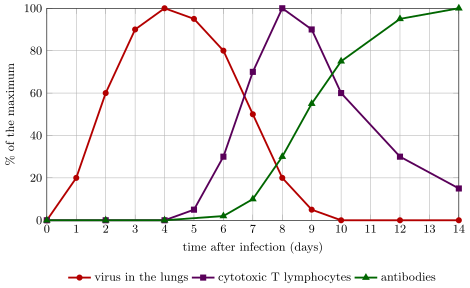
Mice of the same strain are infected through the nose with a respiratory virus that they have never met. The quantity of virus in the lungs, the cytotoxic T lymphocytes specific to the virus in the lungs and the antibodies against the virus in the blood are followed for two weeks (constructed data, expressed as a percentage of the maximum reached by each quantity).
Additional observations:
- from the first day, the lungs show dilated capillaries and many phagocytes;
- the lymph nodes close to the lungs double in size between days 3 and 7;
- mice of the same strain whose T4 lymphocytes have been eliminated produce neither cytotoxic T lymphocytes nor antibodies, and the virus is still abundant in their lungs on day 14;
- mice that have recovered are infected again one month later with the same virus: the virus never exceeds 10% of the previous maximum and disappears in four days; antibodies rise from day 2.
- Describe how the quantity of virus changes during the first four days and name the response that is already at work during this period.
- Indicate on which day the cytotoxic T lymphocytes and the antibodies appear, and explain this delay.
- Explain the swelling of the lymph nodes.
- Relate the decrease of the virus to the two other curves.
- Explain how the cytotoxic T lymphocytes take part in the elimination of the virus.
- Explain how the antibodies take part in it.
- Interpret the observation made on the mice without T4 lymphocytes.
- Interpret the result of the second infection.
- Deduce the principle of a vaccine against this virus.
- Write a summary of the stages of the immune response against this virus, from the entry of the virus to recovery.
Solution
- The quantity of virus increases quickly: 20% of the maximum on day 1, 60% on day 2, 100% on day 4. The virus multiplies in the cells of the lungs. During this period, the non-specific response is at work: an inflammatory reaction (dilated capillaries) and phagocytosis. It slows the infection without stopping it.
- The cytotoxic T lymphocytes are detected from day 5 and reach their maximum on day 8; the antibodies are detected from day 6 and still rise on day 14. The specific response needs several days: the antigen must be presented, the rare lymphocytes that recognize it must be selected, then multiply and differentiate.
- The lymph nodes are the place of the induction and the amplification of the specific response: the selected lymphocytes multiply there by mitosis (clonal expansion), which increases the size of the nodes.
- The virus starts to decrease after day 5, exactly when the cytotoxic T lymphocytes appear; it falls from 95% to 5% between days 5 and 9, while these lymphocytes reach their maximum and the antibodies rise. The elimination of the virus is therefore due to the specific response.
- The infected cells display viral peptides on their class I MHC molecules. The cytotoxic T lymphocytes recognize them, bind to the infected cells and kill them with perforin and enzymes: the cells in which the virus multiplies are eliminated.
- The antibodies, secreted by plasma cells, bind to the free viruses and form immune complexes: the virus is neutralized, it can no longer enter a cell. The complexes are then ingested and digested by phagocytes.
- Without T4 lymphocytes, there are no T helper lymphocytes and therefore no interleukins: the selected B and T8 lymphocytes neither multiply nor differentiate. Neither antibodies nor cytotoxic T lymphocytes are produced, and the virus persists. T4 lymphocytes are indispensable to both specific responses.
- At the second infection, the antibodies rise from day 2 instead of day 6, and the virus is eliminated in four days after a peak ten times lower. This is a secondary response, faster and stronger, due to the memory B and T cells formed during the first infection.
- A vaccine would introduce antigens of the virus in a harmless form (killed or weakened virus, purified viral proteins). It would trigger a primary response and the formation of memory cells, without the disease. A later contact with the real virus would trigger a secondary response that eliminates it quickly.
- The virus enters the lungs and multiplies in their cells. The non-specific response starts at once: inflammatory reaction and phagocytosis. Macrophages that have ingested the virus present its peptides on their class II MHC molecules to T4 lymphocytes in the lymph nodes. The T4 lymphocytes specific to the virus are activated, multiply and become T helper lymphocytes that secrete interleukins. Under their action, the selected B lymphocytes multiply and differentiate into plasma cells, which secrete antibodies; the selected T8 lymphocytes multiply and differentiate into cytotoxic T lymphocytes. The cytotoxic T lymphocytes destroy the infected cells; the antibodies neutralize the free viruses, and the phagocytes eliminate the immune complexes and the debris. The virus disappears in about ten days. Memory cells remain and will ensure a faster and stronger response at the next contact.
What the exercise establishes: following a complete infection and placing each stage of the immune response in time, from the non-specific response to memory.
Similar exercises
- Two ways of transferring an immunity solved
- Are the clones there before the antigen? solved
- T4 lymphocytes and their messenger solved
- A toxin, antibodies and red blood cells solved
- Target cells and killer lymphocytes solved
The course of the chapter · All the exercises of the chapter