Life Sciences (Grade 12 Life Sciences, Lebanon) · Chapter 6 · Direct application of the course
Two injections of the same toxoid
The stages of the immune response · level 2
Statement
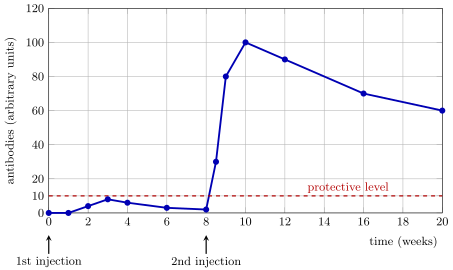
A child receives a first injection of diphtheria toxoid, then a second one two months later. The concentration of antibodies against the diphtheria toxin is followed in the blood. A concentration of at least 10 units is considered protective.
- Define a toxoid and explain why it can be injected without danger.
- Analyze the response to the first injection (delay, maximum, duration).
- Analyze the response to the second injection and compare it with the first.
- Indicate whether the child is protected after the first injection, then after the second.
- Explain the difference between the two responses.
- Justify the practice of booster injections.
Solution
- A toxoid is a toxin that has been treated so that it loses its toxicity while keeping its antigenic determinants. It triggers an immune response against the toxin without causing the disease.
- No antibody is detected during the first week. The concentration then rises slowly to a maximum of 8 units at week 3, and falls to 2 units at week 8: the primary response is late, weak and short.
- After the second injection, the concentration rises in a few days: 30 units after half a week, 100 units at week 10, that is, 12.5 times the first maximum. It then decreases slowly and is still 60 units twelve weeks after the second injection. The secondary response is faster, much stronger and longer-lasting.
- After the first injection, the concentration never reaches 10 units: the child is not protected. After the second, it remains far above 10 units for at least twelve weeks: the child is protected.
- The first contact selected the B and T lymphocytes specific to the toxoid; part of the clone became memory cells, numerous, long-lived and quickly activated. At the second contact, these memory cells multiply at once and give many plasma cells: antibodies are produced sooner and in much greater quantity.
- Each booster repeats the contact with the antigen: it triggers a new secondary response, raises the antibody concentration above the protective level and increases the stock of memory cells, which prolongs the protection.
Similar exercises
- A wound and its phagocytes solved
- Serum or lymphocytes? solved
- Mice without a thymus solved
- Reading an immunodiffusion plate solved
- Three doses of a vaccine solved
The course of the chapter · All the exercises of the chapter