Life Sciences (Grade 12 Life Sciences, Lebanon) · Chapter 8 · Tutorial exercise
Ovarian hormones and structures of the ovary
Regulation of female sex hormones · A. The cycles of the uterus and of the ovary · level 2
Statement
In a woman with a 28-day cycle, the ovaries are examined by ultrasound and the two ovarian hormones are measured in the blood (typical shape of the curves; arbitrary units, each hormone on its own scale).
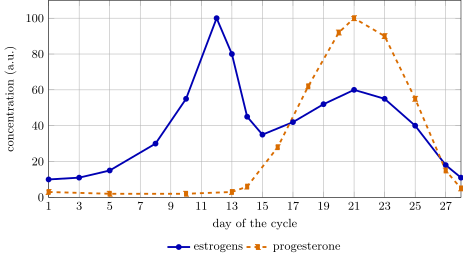
Ultrasound observations: day 5, several small follicles in both ovaries; day 12, one large follicle in the right ovary, the others have regressed; day 15, the large follicle has disappeared, a little fluid is seen near the ovary; day 21, a corpus luteum in the right ovary; day 28, the corpus luteum is much smaller.
- Describe the evolution of estrogens during the cycle.
- Describe the evolution of progesterone during the cycle.
- Locate ovulation, using the ultrasound observations.
- Relate the rise of estrogens between days 5 and 12 to the ultrasound observations.
- Relate the evolution of progesterone to the ultrasound observations.
- Explain the fall of both hormones between days 23 and 28.
- State the consequence of this fall for the uterus.
Solution
- Estrogens are low at the beginning of the cycle (10 a.u.), rise slowly then quickly to a peak of 100 a.u. on day 12, fall to 35 a.u. on day 15, rise again to a second, lower maximum of 60 a.u. on day 21, then fall to about 11 a.u. on day 28.
- Progesterone is almost zero until day 13 (2 to 3 a.u.). It rises from day 14, reaches a peak of 100 a.u. on day 21, then falls to 5 a.u. on day 28.
- The large follicle is present on day 12 and has disappeared on day 15, when fluid is seen near the ovary: the follicle has ruptured. Ovulation took place between these two days, around day 14.
- Between days 5 and 12, one follicle grows while the others regress, and estrogens are multiplied by almost seven (from 15 to 100 a.u.). Estrogens are secreted by the growing follicles, above all by the dominant follicle: the larger it is, the more it secretes.
- Progesterone is absent as long as there is no corpus luteum, rises when the corpus luteum forms after ovulation, is maximal on day 21 when the corpus luteum is fully developed, and falls when it regresses. Progesterone is secreted by the corpus luteum.
- Without fertilization, the corpus luteum regresses at the end of the cycle (it is much smaller on day 28). Since it secretes both progesterone and estrogens during the luteal phase, both hormones fall.
- The endometrium, which is no longer maintained by the two hormones, breaks down: menstruation begins, and with it a new cycle.
What the exercise establishes: attributing each ovarian hormone to the structure that secretes it by relating curves and observations.
Similar exercises
- The endometrium and the cervical mucus during a cycle solved
- What triggers menstruation? solved
- Two pituitary hormones, two roles solved
- From the hypothalamus to the pituitary solved
- Estrogens: a brake or an accelerator? solved
The course of the chapter · All the exercises of the chapter