Life Sciences (Grade 12 Sociology and Economics, Literature and Humanities, Lebanon) · Chapter 2 · Tutorial exercise
Ten years of a health record
Nutritionally caused diseases · C. Synthesis problem: from the plate to the arteries · level 3 (hard)
Statement
Mr. S., 1.75 m tall, has been followed by his doctor for ten years. At 35, he started working in an office, stopped playing football and began to eat often at fast-food restaurants. The graph shows how his mass changed.
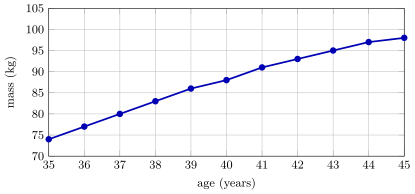
At 45, his blood test shows a cholesterol of 2.5 g/L (usual upper limit: about 2 g/L), his blood pressure is high, and his blood sugar is just below the threshold of diabetes. He also smokes 10 cigarettes a day.
- Read his mass at 35 and at 45, then calculate the average gain per year.
- Calculate his BMI at 35 and at 45, and classify it each time.
- Explain, using the energy balance, the cause of this gain of mass.
- Pick out all the risk factors of cardiovascular disease of Mr. S. at 45.
- Explain how his high cholesterol can lead to a heart attack.
- Name another disease, linked to obesity, that threatens him according to his blood sugar.
- Propose a plan of prevention for Mr. S., with at least four measures.
Solution
- At 35: 74 kg; at 45: 98 kg. Gain: kg in 10 years, that is, kg per year on average.
- . At 35: kg/m², normal weight. At 45: kg/m², obesity.
- Since 35, his expenditure has decreased (office work, no more football) and his intake has increased (fast food, rich in fats and sugars). His energy balance has been positive for years: the surplus has been stored as fat, hence the gain of mass.
- Obesity, physical inactivity, a diet rich in fats, high cholesterol, high blood pressure, tobacco; and also his age and sex, which cannot be changed.
- When there is too much cholesterol in the blood, it is deposited in the wall of the arteries and forms atheromatous plaques, which narrow them (atherosclerosis). If a clot forms on a plaque of a coronary artery, it blocks the passage of the blood: part of the heart muscle no longer receives oxygen and is destroyed. This is a heart attack.
- Type 2 diabetes, whose risk increases with the BMI.
- For example: eat a balanced diet (less fast food, fried food and animal fats; more vegetables, fruits, legumes and vegetable oils; less salt); drink water instead of soft drinks; practice a regular physical activity (at least 30 minutes of walking a day, resume a sport); stop smoking, with medical help; lose weight gradually; have his blood pressure, cholesterol and blood sugar checked regularly.
What the exercise establishes: following a whole chain, from an unbalanced lifestyle to obesity and the risk of cardiovascular disease, and building a plan of prevention.
Similar exercises
- Renourishing a child solved
- Arteries that narrow with age solved
- When risk factors add up solved
- A family and its BMIs solved
- A small surplus every day solved
The course of the chapter · All the exercises of the chapter