Life Sciences (Grade 12 Sociology and Economics, Literature and Humanities, Lebanon) · Chapter 3 · Tutorial exercise
Reading an action potential
Nervous communication · A. The nerve message: nature, propagation and coding · level 2
Statement
The graph shows the recording obtained on a nerve fiber, one electrode inside and one outside, after an effective stimulation given at time 1 ms.
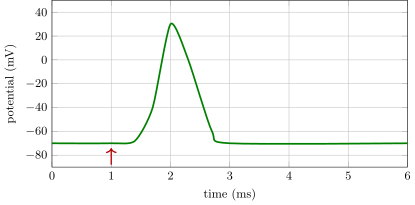
- Read the value of the potential before the stimulation, and name it.
- Read the maximum value reached by the potential, and the time at which it is reached.
- Calculate the amplitude of the action potential.
- Estimate the duration of the action potential, from its start to the return to the resting value.
- Explain why the action potential is called a brief reversal of the resting potential.
Solution
- Before the stimulation, the potential is −70 mV: it is the resting potential.
- The maximum is +30 mV, reached at 2 ms.
- Amplitude: mV.
- The potential leaves the resting value at about 1.4 ms and returns to it at 3 ms: the action potential lasts about 1.6 ms, that is, about 2 ms.
- At rest, the inside of the fiber is negative; at the peak of the action potential, it becomes positive (+30 mV): the polarity is reversed for a very short time, then returns to the resting value.
What the exercise establishes: reading the characteristics of an action potential on a recording.
Similar exercises
- Where is the electrode? solved
- Fast fibers, slow fibers solved
- A pressure on the skin solved
- From nerve to muscle solved
- One neuron, two synapses solved
The course of the chapter · All the exercises of the chapter